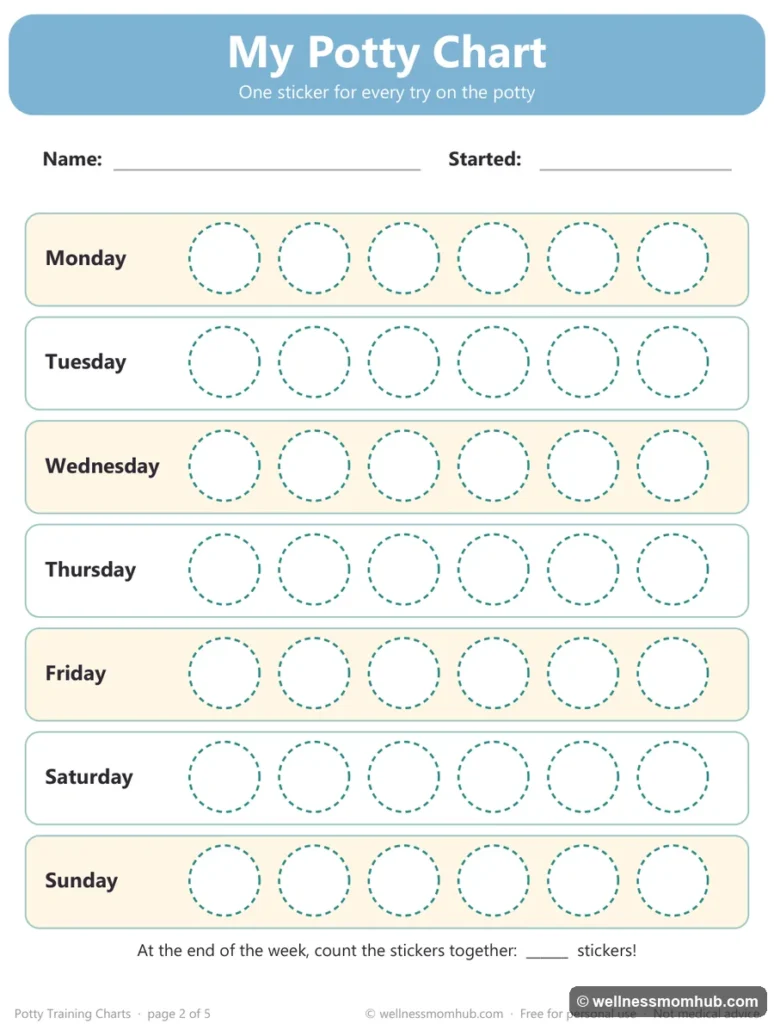
A potty training chart turns a big, abstract skill into something a toddler can see: one sticker or one colored star for every try on the potty. This free printable potty training chart pack has five pages: a readiness checklist, a weekly sticker chart, a sticker path to a star, a color-a-star chart for families who skip stickers, and a potty steps picture card to tape by the toilet.
Quick answer: print the free potty training chart printable, check the readiness signs on page 1, then put a sticker on the chart for every try on the potty, not only every success. Pair each sticker with specific praise, keep accidents low-key, and let the chart fade once using the potty is routine.
Free printable Potty Training Chart Printable
 Save
What’s in the free potty training chart printable
| Page | What it is | Best for |
|---|---|---|
| 1 | Readiness checklist + how to use the charts | Deciding when to start |
| 2 | Weekly potty sticker chart (Monday to Sunday, 6 stickers a day) | Daily tries in the first weeks |
| 3 | Sticker path: 30 circles from START to a star | Kids who love a finish line |
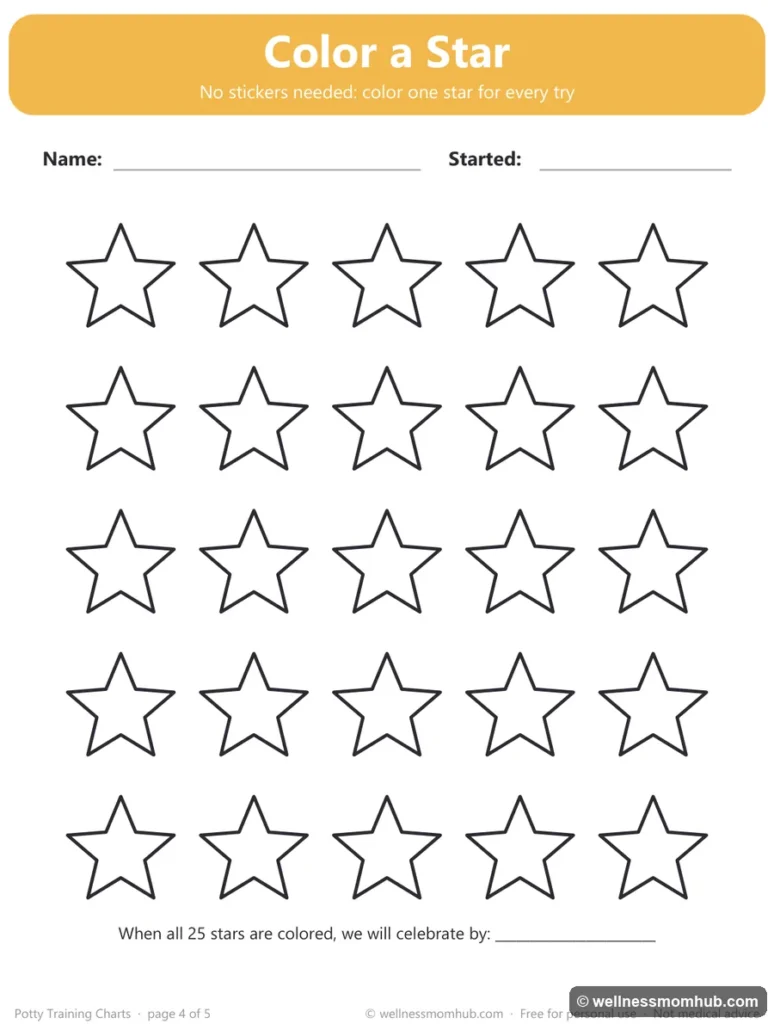
| 4 | Color-a-star chart: 25 stars, no stickers needed | Families who skip stickers and rewards |
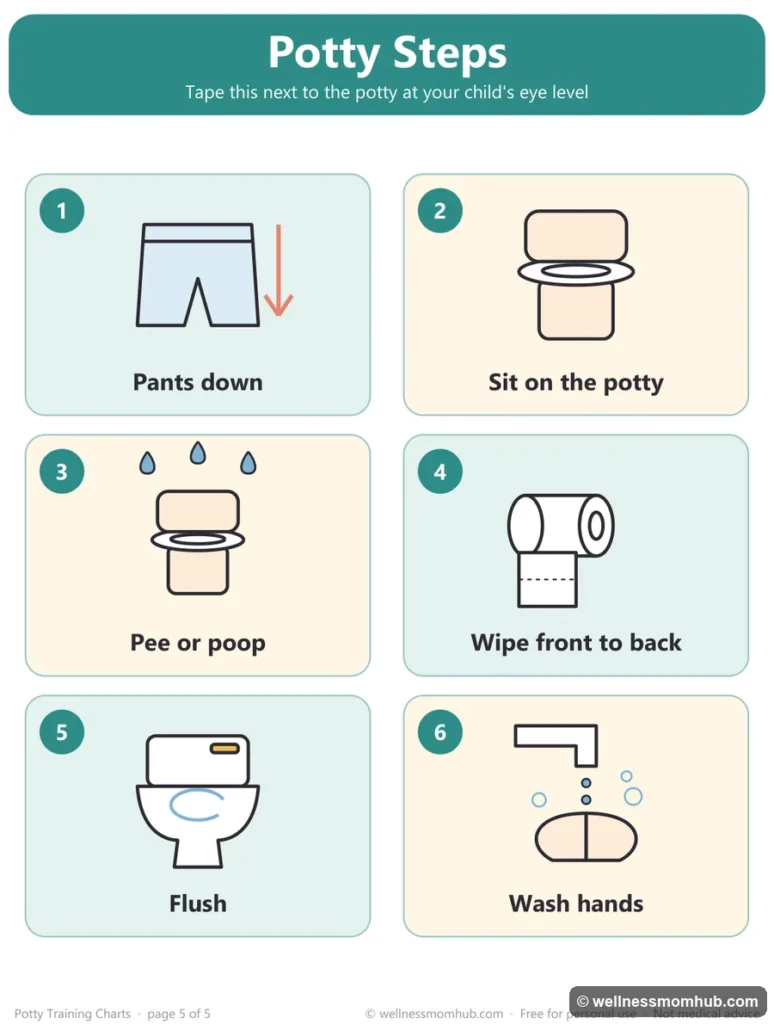
| 5 | Potty steps picture card (6 steps) | Taping next to the toilet |
Everything prints on US Letter paper with no email sign-up. Print two copies of the weekly chart if your child spends time at a grandparent’s house or daycare, so everyone tracks the same way.
Is your child ready to start?
There is no single right age. The American Academy of Pediatrics says children generally show signs of bladder and bowel control between 18 and 24 months, the average age toilet training begins in the United States is between 2 and 3, and most children are trained by 4 (HealthyChildren.org). These are the signs the AAP lists. Page 1 of the printable has them as a checklist:
- Stays dry for at least 2 hours at a time, or wakes up dry from a nap
- Shows signs before peeing or pooping, like grunting, freezing or squatting
- Can follow simple instructions
- Can walk to the bathroom and help undress
- Doesn’t like wet diapers and wants to be changed
- Asks to use the toilet or potty chair
- Asks to wear “big-kid” underwear
 Save
Nemours KidsHealth suggests putting off the start during big changes: a new baby, a move, a switch from crib to bed, travel, or while your child is sick (KidsHealth). A few weeks of waiting usually beats a rough start.
Do potty training sticker charts work?
This is where the experts don’t fully agree, and most chart pages skip it. Nemours KidsHealth recommends small rewards, such as stickers or time reading, for every trip to the potty, and keeping a chart to track successes. The AAP’s HealthyChildren.org page takes a different view: it says mastering the skill is the best reward, advises avoiding treats and punishments, and suggests specific praise instead.
Both agree on the parts that matter most:
- No punishment for accidents. Say “That was an accident,” clean up together and move on.
- Praise the specific thing your child did. “You told me you needed to go!” says more than “Good job.”
- Your child is in charge. Never make a child sit on the potty against their will.
A sensible middle path: use the chart as a record of progress your child can see, not a bribe. A sticker or a colored star is the reward. Skip candy and toys for each trip. If you’d rather avoid stickers altogether, the color-a-star page works the same way without any prize.
 Save
How to use a potty chart, step by step
- Pick one chart. The weekly chart suits most toddlers. The sticker path suits kids who like counting to a goal.
- Hang it where your child can reach. Next to the potty or on the bathroom door, at their eye level.
- Build potty times into the day. First thing in the morning (the AAP suggests making this a habit), after waking up dry from a nap, and 15 to 30 minutes after meals, when many kids need to poop (KidsHealth).
- Reward tries, not just results. Sitting on the potty counts. In the first weeks, a sticker for every try keeps it positive.
- Let your child put the sticker on. Choosing and sticking it is part of the fun.
- Count stickers together at the end of the week. Talk about what went well, not what didn’t.
- Let it fade. Potty charts do their job in the first weeks. When using the potty is routine, the chart can come down. Many kids stop asking for it on their own.
 Save
A predictable day makes this easier. Our toddler schedule by age shows where potty breaks fit around meals and naps.
The potty steps picture chart
Toddlers learn routines best in small, visible steps. The last page of the printable shows six:
- Pants down
- Sit on the potty
- Pee or poop
- Wipe front to back
- Flush
- Wash hands
 Save
Wiping front to back keeps germs from spreading toward the bladder, which matters most for girls, and both boys and girls need to learn to wash their hands well afterward (HealthyChildren.org). KidsHealth notes it’s usually best for boys to learn sitting down first before peeing standing up.
 Save
Potty chart reward ideas (that aren’t candy)
- Choosing the sticker and where it goes
- An extra bedtime story
- Picking the song for a quick dance party
- A video call to show grandma the chart
- Choosing new big-kid underwear once the potty is going well (a KidsHealth idea)
- For the sticker path: a small outing when your child reaches the star, like the park or the library
Accidents, setbacks and how long it takes
Potty training often takes 3 to 6 months, and staying dry at night can take months or even years longer, according to KidsHealth. Setbacks are normal. Many kids who were using the potty have accidents again during a stressful time, such as a new sibling.
Stay calm, keep the routine, and keep praising tries. Talk to your child’s doctor if your child is 4 or older and not yet potty trained, if a trained child is regularly having problems, or if you have any other concerns. This guide is general information, not medical advice.
Wondering where your child is in the toddler years? See what age is a toddler. Once potty skills are in place, a chore chart by age is a natural next step for little helpers, and our bedtime routine for 3-year-olds builds in a last potty trip before bed.
Potty training chart FAQ
What is a potty training chart?
A potty training chart is a simple page where your child adds a sticker or colors a shape every time they try the potty. It shows progress they can see, which helps a toddler understand a skill that is otherwise hard to picture.
What age should you start using a potty chart?
Start when your child shows readiness signs, not at a set age. Many children show signs of bladder and bowel control between 18 and 24 months, and the average start in the US is between 2 and 3, according to the AAP.
Should a potty chart reward every try or only successes?
Every try, especially in the first weeks. Sitting on the potty is real progress, and rewarding tries keeps the whole thing positive. Later you can switch to stickers for successes only.
Do I need a different potty chart for boys and girls?
No. The same charts work for everyone. Boys usually learn sitting down first, and girls should learn to wipe from front to back.
What if my child refuses the potty?
Don’t force it. Take a short break, keep the potty in sight and try again in a week or two. If your child is 4 or older and still not trained, talk to their doctor.
Is the potty training chart printable free?
Yes. All five pages are free to print at home with no email sign-up.