
A visual schedule for toddlers is a row of picture cards that shows what happens now and what comes next: potty, breakfast, shoes on, car. Toddlers can’t read a list or tell time, but they can read a picture, and knowing what’s coming makes transitions much easier for everyone. Below is how to make a visual schedule for kids step by step, how to use it every day, sample routines, and 24 free printable picture cards with a schedule board and a First/Then board.
Quick answer: pick the hardest part of your day, choose 3 to 6 picture cards for its steps, and stick them in order at your child’s eye level. Check the schedule together (“Let’s see what’s next”), let your child move each finished card to an All done pocket, and put a fun step right after a hard one.
Free printable Visual Schedule Printable for Toddlers
 Save
What is a visual schedule?
A visual schedule uses pictures to show the steps of a routine or a day, in order. According to the National Center for Pyramid Model Innovations, a visual schedule gives young children predictability (they know what activity or routine is coming and when) and consistency (the routine is the same each time). Visuals help children understand what’s happening “now” and “next,” and act as reminders for spoken directions (ChallengingBehavior.org).
Visual schedules are used in preschools, in therapy and at home. You don’t need a diagnosis or a special reason to use one. Most toddlers benefit from seeing their day.
Why a toddler visual schedule helps
- Fewer battles at transitions. “The schedule says shoes are next” is easier to accept than another reminder from you.
- Less repeating yourself. The pictures do part of the talking.
- More independence. Kids can check what’s next on their own and feel proud moving a card to All done.
- A sense of control. Toddlers do better when they know what’s coming, especially on busy or unusual days.
 Save
How to make a visual schedule for kids
These steps follow the Pyramid Model guide for families:
- Pick the time of day. Start with the part of the day your child finds hardest, like mornings, bedtime or leaving the house. A schedule can cover a few steps or a whole day.
- List the steps. For bedtime, that might be bath, pajamas, brush teeth, potty, book, bed.
- Put fun after hard. Structure the routine so a favorite activity follows a challenging one: clean up, then outside; brush teeth, then books.
- Print and protect the cards. Print on cardstock and cover them with clear tape or contact paper so they survive little hands.
- Stick them up in order. Use tape, Velcro dots or magnets on a board, a poster or the fridge.
- Post it at your child’s eye level somewhere you pass often, like the kitchen or the bathroom door.
 Save
For toddlers, fewer cards is better. Three to six steps is plenty. You can always add more as your child gets used to it.
How to use a visual schedule every day
- Teach it. Show your child the cards and walk through them together the first few times.
- Refer to it. “We just got home. Let’s check your schedule to see what’s next.”
- Talk about it. “You got dressed. Now it’s time for breakfast!”
- Make it active. Let your child flip a finished card over or move it into the All done pocket.
- Celebrate. Notice the hard steps out loud: “You cleaned up all by yourself!”
 Save
First/Then boards
A First/Then board is the simplest visual schedule: just two cards. “First shoes, then park.” The Pyramid Model guide suggests using it to help with a transition, to break a routine into smaller steps, or to help a child finish a task they don’t love before something they do. Put the preferred activity on the “then” side.
First/Then works well for 2-year-olds who aren’t ready for a whole row of cards, and for one-off moments like getting into the car seat.
Visual schedule examples
| Routine | Cards, in order |
|---|---|
| Morning | Wake up, potty, get dressed, breakfast, brush teeth, shoes on |
| Day at home | Breakfast, play, outside, lunch, nap, snack |
| Bedtime | Bath, pajamas, brush teeth, potty, read a book, bedtime |
| Leaving the house | Potty, shoes on, coat on, car ride, daycare or school |
| Potty training | Potty, wash hands, play (a short loop you repeat during the day) |
 Save
A potty training visual schedule works best paired with our potty training chart, which has a potty steps picture card. For a full day plan by age, see our toddler schedule, and for bedtime, our bedtime routine for 3-year-olds.
 Save
Tips that make it stick
- Use the same words every time. If the card says “Shoes on,” say “shoes on.”
- Make your own cards for anything special. A photo of your child’s real daycare, car seat or grandma works even better than a drawing.
- Keep it where it’s used. A bedtime schedule belongs by the bathroom, not on the fridge downstairs.
- Change it when life changes. New baby, new daycare or a trip? Update the cards before the big day.
- Give it two weeks. Routines take repetition. Keep using the schedule even on good days.
 Save
Printable visual schedule or an app?
For toddlers, paper usually wins. Cards they can touch, move and drop in a pocket make the schedule something they do, not just something they look at, and it stays on the wall without a screen. Older kids who can read sometimes like a checklist or an app. Whatever you pick, keep it consistent.
Free visual schedule printable
The free visual schedule printable is a 5-page PDF:
- Page 1: how to make and use it, plus a First/Then board.
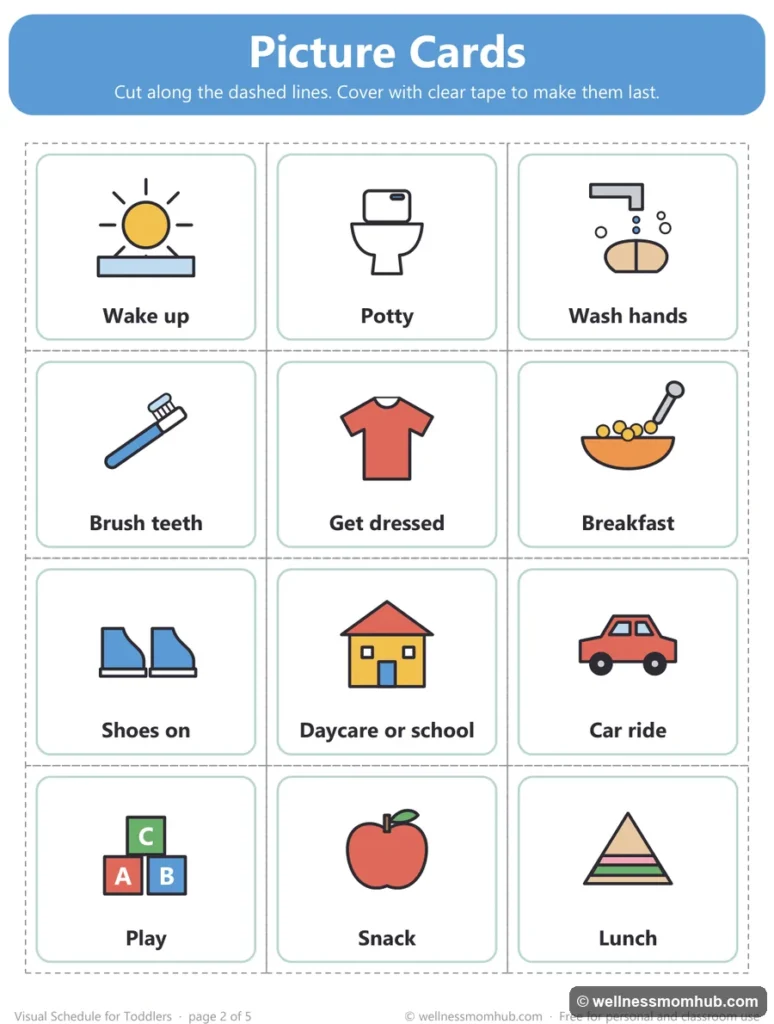
- Pages 2 and 3: 24 picture cards, including wake up, potty, wash hands, brush teeth, get dressed, meals, nap, outside, bath, pajamas, bedtime and All done.
- Page 4: a schedule board with card-sized slots numbered 1 to 6, and an All done pocket to fold.
- Page 5: sample schedules for morning, a day at home and bedtime.
Free for personal and classroom use, no email required. Our chore chart by age is a good next step once routines click.
Visual schedule FAQ
How do you make a visual schedule for kids?
Pick a routine, list 3 to 6 steps, find or draw a picture for each, and stick them in order at your child’s eye level. Put a fun step after a hard one, and add an All done pocket so your child can move each finished card.
Can you give some examples of visual schedules?
A morning schedule (wake up, potty, get dressed, breakfast, brush teeth, shoes on), a bedtime schedule (bath, pajamas, brush teeth, potty, book, bed) and a First/Then board (first clean up, then outside).
Where can I find a printable visual schedule for my child?
Our free printable has 24 picture cards, a schedule board and a First/Then board. The National Center for Pyramid Model Innovations also has free visual supports for families.
What age can toddlers use a visual schedule?
A visual schedule for toddlers can start with a two-card First/Then board, then move to a short schedule of 3 to 6 cards as they get used to it. Go at your child’s pace.
Is a visual schedule only for kids with autism?
No. Visual schedules are widely used with children who have autism or other needs, and they help many toddlers and preschoolers who simply do better when they know what’s next.
Should I use a visual schedule app?
For toddlers, physical cards usually work better because kids can touch and move them. Apps can suit older children who read. The best schedule is the one you use every day.
For mornings with a child who’s ready for a little more, try our morning routine chart for kids, with a picture chart and a checklist for ages 5 to 8.