Fine motor activities for toddlers are simple games that work the small muscles in the hands and fingers: peeling stickers, squeezing play dough, posting objects through a slot, scribbling, and threading. Those same muscles later handle spoons, buttons, zippers, crayons, and eventually pencils. This guide sorts 35 easy fine motor activities by age, from 12 months to 5 years, and every toddler idea uses items too big to be a choking hazard.
Quick answer: for 1-year-olds, try posting balls into a container, peeling large stickers, and finger painting. For 2-year-olds, try play dough, tearing paper, pouring, and thick crayons. For 3- to 5-year-olds, try threading large beads, tongs and tweezers, child-safe scissors, and our free pre-writing tracing pages. Five to ten minutes a day is plenty.
What are fine motor skills?
Fine motor skills are the small, precise movements of the hands and fingers, coordinated with the eyes. They include gripping, pinching, twisting, squeezing, and using both hands together (one holds while the other works). Gross motor skills are the big movements: running, climbing, jumping, and throwing.
Fine motor skills matter because so much of daily life depends on them: feeding themselves, getting dressed, opening containers, drawing, and, later, writing. Children build these skills through everyday play long before they hold a pencil.
Fine motor milestones by age
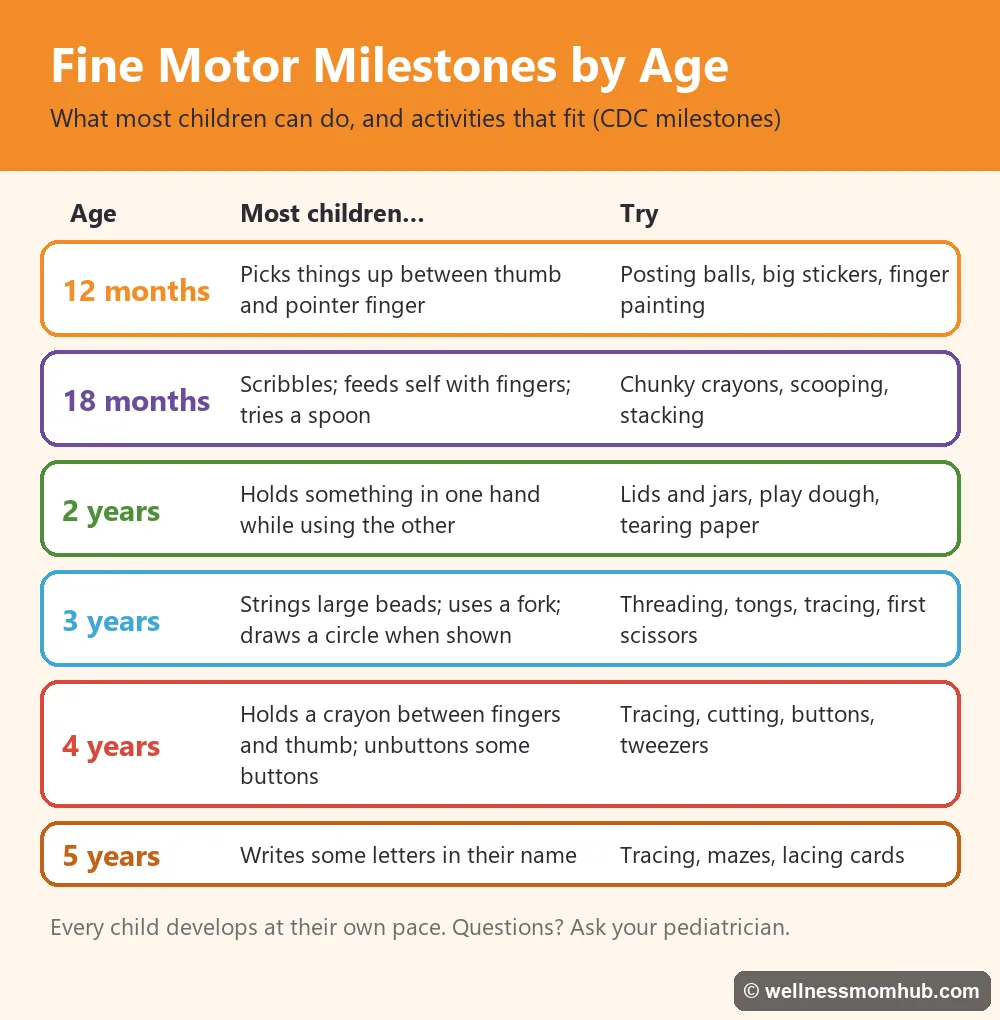
Every child develops at their own pace, but these are hand-skill milestones the CDC lists for most children by each age:
| By this age | Most children… | Activities that fit |
|---|---|---|
| 12 months | Pick things up between the thumb and pointer finger, like small bits of food | Posting, finger painting, big stickers |
| 18 months | Scribble, feed themselves with their fingers, and try to use a spoon | Chunky crayons, scooping, stacking |
| 2 years | Hold something in one hand while using the other, like holding a container and taking off the lid | Lids and jars, play dough, tearing paper |
| 3 years | String items together, like large beads; use a fork; draw a circle when shown how | Threading, tongs, tracing, first scissors |
| 4 years | Hold a crayon or pencil between fingers and thumb (not a fist); unbutton some buttons | Tracing, cutting, buttons, tweezers |
| 5 years | Write some letters in their name | Tracing, mazes, lacing cards |
Source: CDC, Learn the Signs. Act Early. If your child isn’t reaching a milestone, has lost a skill, or you’re simply unsure, talk to your pediatrician and ask about developmental screening. Acting early helps.
Fine motor activities for 1-year-olds (12–24 months)
At this age, everything goes in the mouth. Use objects bigger than a toddler’s mouth, stay close, and keep sessions short. More ideas for this age are in our activities for 1-year-olds.
- 1. Ball posting. Cut a hole in the lid of an oatmeal canister and let your toddler push in tennis balls or large balls. Skill: grasp and release.
- 2. Big-sticker peeling. Stick large stickers or strips of painter’s tape on a high chair tray to peel off. Skill: pincer grasp.
- 3. Finger painting. Washable paint on paper, or plain yogurt on the tray for toddlers who taste everything. Skill: finger isolation.
- 4. Scarf pull. Stuff silk scarves into an empty tissue box and let them pull them out one by one. Skill: pinch and pull.
- 5. Block stacking. Stack two or three large blocks, then knock them down. Skill: controlled release.
- 6. Lids on, lids off. Plastic containers with easy, loose lids. Skill: using two hands together.
- 7. Finger foods. Self-feeding soft, safe finger foods is fine motor practice at every meal. Follow your pediatrician’s advice on which foods are safe and how to cut them.
- 8. Board book page turning. Thick board book pages are easier to grip than paper. Skill: finger strength.
Fine motor activities for 2-year-olds
Two-year-olds can squeeze, tear, pour, and scribble with more control. Keep supplies large, and use taste-safe options while they still mouth things. For a full list of everyday ideas, see our activities for 2-year-olds.
- 9. Play dough. Roll, squish, pinch, and press with cookie cutters. Use store-bought or cooked dough. The CDC advises against letting children play with raw flour dough. Skill: hand strength.
- 10. Paper tearing. Tear strips of colored paper and stick them on contact paper. Skill: two-hand coordination.
- 11. Pouring station. Pour water or dry cereal between cups and a small pitcher. Stay close during water play. Skill: wrist control.
- 12. Chunky crayon scribbling. Tape a big sheet to the table so it doesn’t slide. Our free Thanksgiving coloring pages start with big, simple shapes. Skill: grip and control.
- 13. Colander and pipe cleaners. Poke pipe cleaners through the holes of an upside-down colander. Fold the sharp ends over first. Skill: precision.
- 14. Clothespin clipping. Clip large clothespins onto the edge of a box or a paper plate. Skill: pinch strength.
- 15. Sticker lines. Draw a line and have them put stickers along it. Skill: placement and pincer grasp.
- 16. Scoop and transfer. Scoop dry pasta or cereal from one bowl to another with a large spoon. Skill: spoon control.
- 17. Sponge squeezing. Soak a sponge in a shallow tub of water and squeeze it into a cup. Skill: grip strength.
- 18. Washi tape pull. Stick strips of tape across a toy car or a table edge to peel off. Skill: fingertip control.
Fine motor activities for preschoolers (ages 3–5)
Preschoolers are ready for smaller tools and more precision. Small items like beads and pom-poms are fine from here with a grown-up nearby, as long as younger siblings can’t reach them. Our activities for 3-year-olds and activities for 4-year-olds build on these.
- 19. Threading large beads. String large wooden beads or rigatoni onto a shoelace with a taped end. Skill: two-hand coordination (a CDC 3-year milestone).
- 20. Tong transfers. Move pom-poms or cotton balls between bowls with kitchen tongs. Skill: squeeze and release.
- 21. Tweezer sorting. Sort small pom-poms by color into an ice cube tray with plastic tweezers. Skill: tripod pinch.
- 22. First scissors. Snip strips of paper with child-safe scissors, then move on to the cutting page in our tracing pack. Skill: scissor control.
- 23. Tracing lines. Straight lines first, then zigzags, waves, and loops. Skill: pre-writing strokes.
- 24. Lacing cards. Punch holes around a cereal-box shape and lace yarn through. Skill: hand-eye coordination.
- 25. Play dough snakes and balls. Roll thin snakes and tiny balls, then press beads or buttons in. Skill: finger strength.
- 26. Button practice. Practice on a big-button coat laid on the floor. Skill: buttoning (unbuttoning is a CDC 4-year milestone).
- 27. Rubber band board. Stretch rubber bands over pegs or a cardboard tube. Supervise. Skill: finger strength.
- 28. Eyedropper painting. Drip watered-down paint onto coffee filters. Skill: squeeze control.
- 29. Sticker mosaics. Fill in a shape outline with small dot stickers. Skill: precision.
- 30. Building with small blocks. Interlocking bricks and small building blocks. Skill: push and pull strength.
Fine motor games for preschoolers
Turn practice into a game and it doesn’t feel like practice at all.
- 31. Feed the monster. Cut a mouth in a box and “feed” it pom-poms with tongs. Count each bite.
- 32. Coin bank race. Push coins or plastic tokens through a slot. Coins are for preschoolers only, never toddlers.
- 33. Cotton ball race. Move cotton balls across the table with clothespins. The first one to five wins.
- 34. Sticker treasure hunt. Hide stickers under paper flaps for them to find and peel.
- 35. Bingo with markers. Cover pictures with small paper squares or mini pom-poms. Our free Halloween picture bingo works for non-readers.
Free pre-writing tracing pages
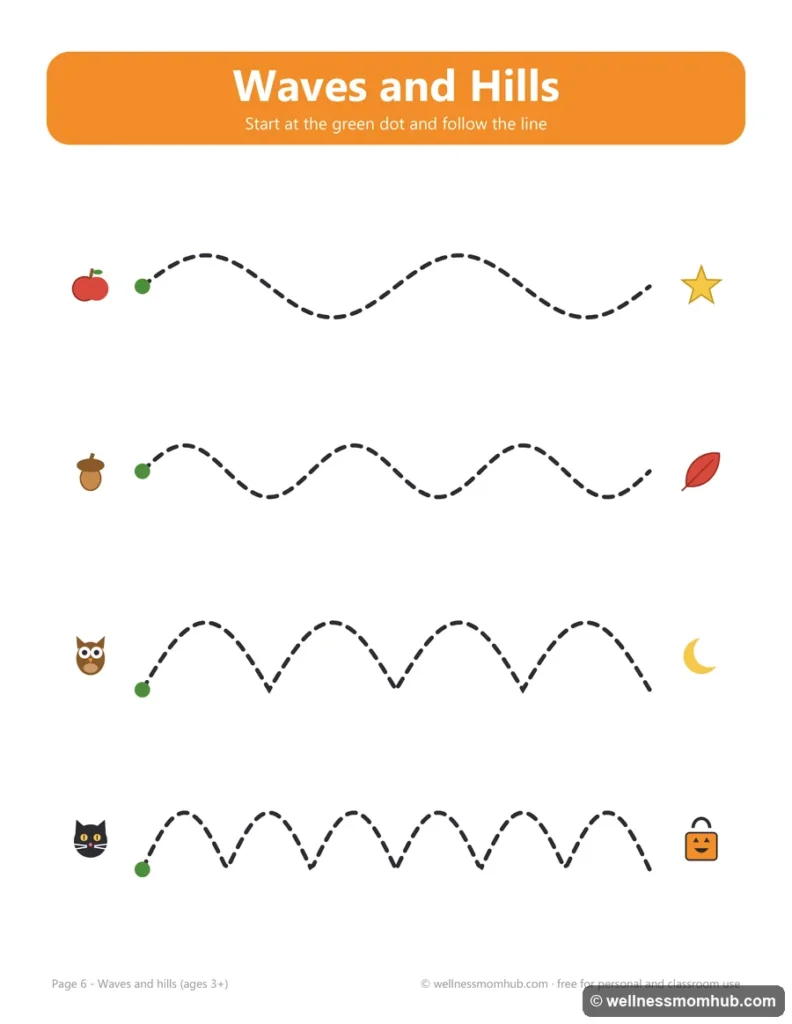
The free pre-writing tracing lines printable is a 9-page PDF: a how-to page and eight practice pages. It covers straight lines, top-to-bottom lines, slanted lines, zigzags, waves and hills, loops, shapes (circle, square, triangle, star), and a cutting page with straight, zigzag, wavy, and curvy strips. Every line starts at a green dot next to a picture, so children know where to begin.
- Start easy. Begin with straight lines, and move on when it feels easy for your child, not because of age.
- Crayon or finger first. Chunky crayons, dot markers, or a fingertip work before pencils.
- Reuse it. Slide a page into a sheet protector and trace with a dry-erase marker.
Safe supplies by age
| Supply | Under 3 | Ages 3–5 |
|---|---|---|
| Beads, pom-poms, buttons | Skip, or use only items too big to fit in the mouth | Yes, with a grown-up nearby |
| Play dough | Store-bought or cooked only, supervised | Yes |
| Scissors | No | Child-safe scissors, supervised |
| Coins | Never | Supervised, and kept away from younger siblings |
| Crayons and markers | Chunky and washable | Regular sizes are fine |
The US Consumer Product Safety Commission warns that toys and items with small parts are a choking hazard for children under 3 (CPSC toy safety). The American Academy of Pediatrics lists coins, marbles, and toys with small parts among common household choking hazards (AAP, HealthyChildren.org).
Tips for fine motor practice at home
- Little and often. Five to ten minutes a day beats one long session.
- Work at a table, sitting well. Feet on the floor or a footrest helps steady the hands.
- Let them struggle a little. Wait a few seconds before helping with a lid or a sticker.
- Use real life. Snapping containers, zipping bags, peeling a banana, and pouring water all count.
- Follow their interest. A child who loves cars will happily peel tape off a car track.
Pair fine motor play with movement. Our sensory bin ideas combine scooping and pouring with lots of hands-on texture.
Fine motor activities FAQ
What are examples of fine motor activities for toddlers?
Peeling stickers, posting balls into a container, play dough, tearing paper, scribbling with chunky crayons, pouring, stacking blocks, and clipping clothespins are all fine motor activities for toddlers. They work the small muscles of the hands and fingers.
How can I improve my toddler’s fine motor skills?
Offer a few minutes of hands-on play every day: play dough, stickers, scooping, tearing paper, and self-feeding. Let your toddler do things for themselves, like opening easy lids or putting toys in a basket, even when it’s slower.
What is the difference between fine motor and gross motor skills?
Fine motor skills use the small muscles of the hands and fingers, for gripping, pinching, and drawing. Gross motor skills use the big muscles of the arms, legs, and body, for running, jumping, climbing, and throwing.
At what age can toddlers use scissors?
Many children start snipping paper with child-safe scissors around age 3, with a grown-up close by. Begin with snipping strips before cutting along lines.
When should I worry about my child’s fine motor skills?
Talk to your pediatrician if your child isn’t reaching the milestones for their age, has lost skills they once had, or you have any concern. The CDC’s free milestone checklists can help you prepare for that conversation.