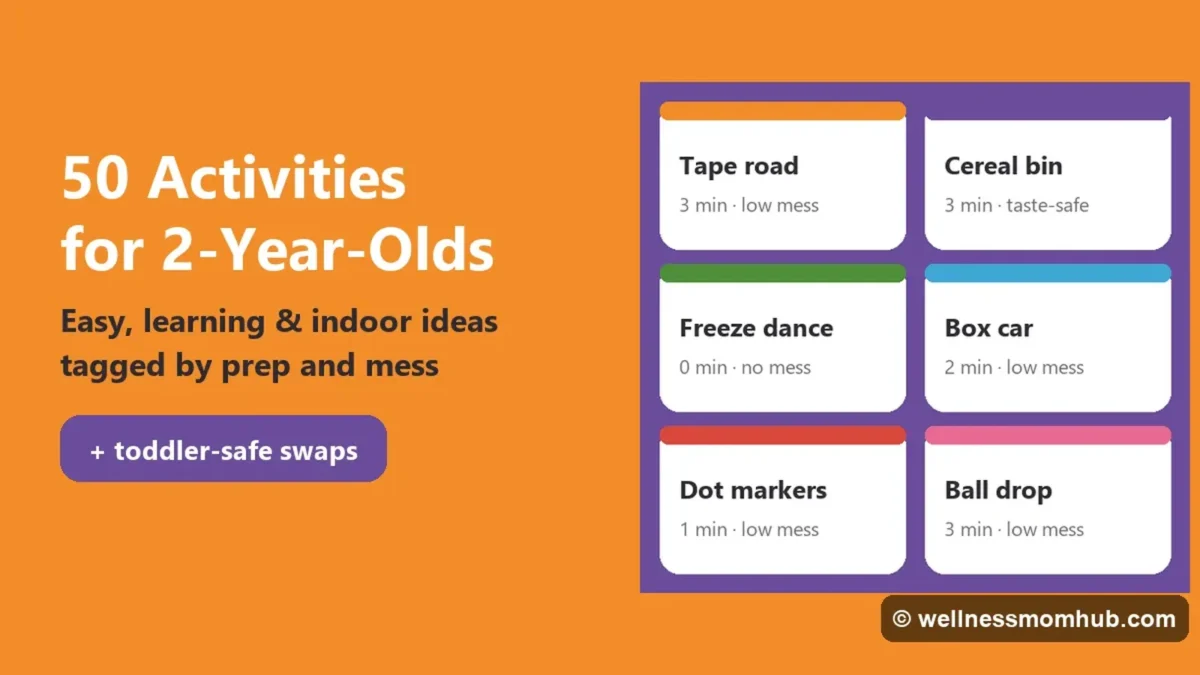
The best activities for 2 year olds are short, hands-on, and use things you already own: a tape road for toy cars, a taste-safe sensory bin, water pouring at the sink, a cardboard box, and freeze dance. Most take under five minutes to set up. All 50 ideas below are tagged with prep time and mess level, and every one is chosen to be safe for a toddler who still puts things in their mouth.
Quick answer: rotate three or four short activities instead of hunting for one long one. Mix one sensory activity (#14–20), one art or learning activity (#21–27, #36), one movement game (#41–46), and one zero-prep fallback (#4, #12, #34, #37). Swap as soon as interest fades: most two-year-olds move on after a few minutes, and that’s normal.
Free printable Boredom Buster Cards Printable
Want the ideas within reach? The free Boredom Buster cards turn quick toddler activities into cut-and-fold cards for a jar on the counter. When the day stalls, pull one instead of thinking up something new.
 Save
What makes a good activity for a 2-year-old
Good activities for two-year-olds are open-ended (no single right way to do it), hands-on, and short. Real objects beat toys with one trick. A rotation of small activities you can swap quickly works far better than one elaborate setup.
Two quick tests help. Can your child do most of it alone? Can you clean it up in under two minutes? If both are yes, it’s a keeper for everyday use.
One safety rule shapes this whole list: two-year-olds still put things in their mouths, so every idea here avoids small parts, or swaps them for bigger, taste-safe options. The American Academy of Pediatrics lists toys with small parts, balloons, marbles, and small round objects among the most common choking hazards (AAP, HealthyChildren.org). Stay close during anything with water, and supervise sensory play.
How the list is organized
The 50 ideas are grouped by type: at-home quick wins, indoor, sensory, art, crafts, screen-free, energy-burners, and out-of-the-house. Each one is tagged with setup time and how much mess to expect.
| Category | Best for | Typical prep | Typical mess |
|---|---|---|---|
| At-home quick wins | “I need something in 60 seconds” | 1–2 min | Low |
| Indoor | Rainy days, sick days, the late afternoon | 2–5 min | Low–Medium |
| Sensory | Longer stretches of focused play | 3–5 min | Medium–High |
| Art | Quiet, seated time | 3–5 min | Medium–High |
| Crafts | Together-time with a grown-up | 5–10 min | Medium |
| Screen-free go-tos | Replacing the tablet reflex | 1–3 min | Low |
| Movement | Burning energy before a nap | 0–2 min | Low |
| Out of the house | Resetting a long day | 5 min | Low |
60-second setups from the kitchen and junk drawer
These need almost nothing beyond what’s in your kitchen or junk drawer. They’re the zero-energy options for when you need your toddler busy right now.
- 1. Muffin tin sorting. Hand over a muffin tin and a bowl of big items to drop into each cup: chunky blocks, balled-up socks, or large plastic lids. Why it works: the drop-and-fill loop is satisfying at this age. Prep: 1 min · Mess: low.
- 2. Tape road on the floor. Lay painter’s tape “roads” across the floor for toy cars. Why it works: it invites pretend play and narration, and the tape peels up clean. Prep: 3 min · Mess: low.
- 3. Laundry basket boat. Your toddler sits in a laundry basket with a couple of stuffed animals while you “sail” it slowly around the room. Why it works: it costs nothing, and the basket doubles as toy cleanup afterward. Skip it with a climber. Prep: 1 min · Mess: low.
- 4. The “yes” cupboard. Fill one low kitchen cupboard with plastic bowls, wooden spoons, and lids they can pull out freely. Why it works: it feels like getting away with something, and it keeps them busy near you while you cook. Prep: 2 min once, then reusable · Mess: low.
- 5. Sticker line-up. A sheet of large stickers and a piece of paper. Why it works: peeling stickers is fiddly fine-motor work that holds attention longer than you’d expect. Prep: 1 min · Mess: low.
More quick setups
- 6. Ball drop tube. Tape a wide cardboard tube to the wall and drop ping-pong balls or balled-up socks through it into a basket. Why it works: the “where did it go?” surprise never gets old. Prep: 3 min · Mess: low.
Indoor ideas for rainy and sick days
Indoor activities work best when they let a toddler move without leaving the house. This is a rainy-day and sick-day rotation. For more ideas by situation, see our toddler activities at home.
- 7. Pillow fort. Pull every couch cushion and blanket into one pile and crawl inside. Why it works: the building is half the fun, and it resets the mood on a hard day. Prep: 5 min · Mess: medium.
- 8. Indoor obstacle course. Cushions to climb, a broom handle on two books to step over, a tape line to jump. Why it works: it burns real energy and practices balance and climbing. Prep: 4 min · Mess: low.
- 9. Beach ball keep-up. Try to keep an inflated beach ball off the floor. Why it works: it floats slowly enough for little hands to hit, and it’s far safer than a balloon (balloons are a choking hazard for children under 8, per the CPSC). Prep: 1 min · Mess: low.
- 10. Colander and pipe cleaners. Flip a colander over and let your toddler poke pipe cleaners through the holes. Fold the sharp tips over first. Why it works: quiet, seated, and surprisingly absorbing. Prep: 1 min · Mess: low.
- 11. Sock basketball. Roll socks into balls and toss them into a laundry basket “hoop.” Why it works: zero setup, and it turns folding laundry into a game. Prep: 1 min · Mess: low.
More rainy day ideas
- 12. Cardboard box anything. A big box becomes a car, a house, a boat, or a tunnel. Why it works: it’s one of the most reliable open-ended props there is. Keep your delivery boxes. Prep: 2 min · Mess: low.
- 13. Flashlight hunt. Dim the lights and hunt for stuffed animals with a flashlight. Why it works: the novelty makes an ordinary game feel big. Some younger twos find the dark unsettling, so keep a lamp on and try again in a few months if it doesn’t land. Prep: 3 min · Mess: low.
Sensory play that is safe for mouthers
Sensory play holds attention because the texture itself is the entertainment. It’s messier, so set it up on a towel, in the bath, or outside. Stay in the room, and choose taste-safe fillers while your child still mouths things. Our sensory bin ideas have 35 more setups sorted by filler.
- 14. Taste-safe cereal bin. A bin of O-shaped cereal or rolled oats with cups and scoops to pour and dump. Why it works: the pouring loop holds attention, and it doesn’t matter if some ends up in a mouth. Prep: 3 min · Mess: high.
- 15. Frozen toy rescue. Freeze large plastic toys in a container of water overnight, then free them with warm water and a spoon. Why it works: part science, part puzzle. Use toys too big to fit in a mouth. Prep: 2 min plus overnight · Mess: medium.
- 16. Yogurt or whipped cream tray. A blob of plain yogurt or whipped cream on the high chair tray to swirl and draw in. Why it works: all the swirl-and-draw fun of shaving cream, but it’s food, so tasting is fine. Prep: 1 min · Mess: high.
- 17. Water pouring station. Two cups, a small pitcher, and a little water at the sink or in a shallow tub. Why it works: water is the original sensory bin. Stay with them, and empty any water container as soon as play ends. Prep: 2 min · Mess: medium.
More sensory play ideas
- 18. Play dough. Store-bought dough, or a homemade batch cooked on the stove, to roll, squish, and press with cookie cutters. Skip no-cook recipes: the CDC advises against letting children play with dough made with raw flour. Why it works: squishing and pressing builds hand strength, and one tub lasts for months. Prep: 1 min · Mess: medium.
- 19. Big pasta scoop and dump. Large dry pasta shapes (rigatoni or big shells) with funnels and containers, for toddlers who no longer mouth everything. Why it works: same appeal as the cereal bin, with a louder, clinkier texture. Contain it on a sheet. Prep: 3 min · Mess: high.
- 20. Texture basket. A basket with a sponge, a scrap of velvet, a wooden spoon, a large piece of bubble wrap, and a cool metal cup. Why it works: naming each texture together (“soft,” “bumpy,” “cold”) is great early vocabulary. Prep: 3 min · Mess: low.
Art: process over product
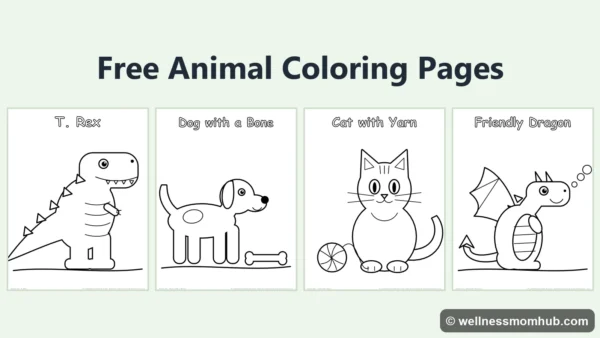
Art at two is about the doing, not the result. Big paper, washable everything, low expectations. If your toddler loves coloring, our free Thanksgiving coloring pages start with big, simple shapes made for this age.
- 21. Finger painting. Washable paint, a big sheet of paper, and bare hands. Why it works: it’s the most direct art there is at two. Strip down to a diaper, keep it off the carpet, and head straight to the bath after. Prep: 2 min · Mess: high.
- 22. Sponge stamping. Cut a sponge into chunks and press into paint to stamp shapes. Why it works: easier for little hands to control than a brush. Prep: 3 min · Mess: medium.
- 23. Dot markers. Big washable dot markers on plain paper. Why it works: one press makes a mark, so the payoff is instant. Prep: 1 min · Mess: low.
- 24. Nature paintbrushes. Tape a leaf or a sprig of pine to a stick and paint with it. Why it works: an outdoor hunt plus painting, two activities in one. Prep: 4 min · Mess: medium.
- 25. Ice cube painting. Freeze watered-down washable paint into cubes (add a craft stick handle) and slide them across paper. Why it works: the melting is half the fascination. Prep: 3 min plus freezing · Mess: medium.
- 26. Crayon roll. Tape a long sheet of paper to the floor and hand over chunky crayons for full-arm scribbling. Why it works: taped paper doesn’t slide, which cuts the frustration. Prep: 2 min · Mess: low.
More process art ideas
- 27. Contact paper collage. Tape contact paper sticky-side-out to the wall and press on large squares of tissue paper and paper shapes. Why it works: no glue, no drying, and it stays up like a real art piece. Prep: 3 min · Mess: low.
Simple crafts to do together
Crafts at this age work best as together-time: your toddler chooses and sticks, and you handle the scissors and glue. Keep the goal loose.
- 28. Paper plate faces. Stick on large paper shapes for eyes, a nose, and a mouth, and draw the details with a marker. Why it works: they pick the pieces, you do the tricky parts. Skip googly eyes, which are small enough to choke on. Prep: 5 min · Mess: medium.
- 29. Cardboard ring threading. Cut a paper towel tube into wide rings and thread them onto a jump rope or thick yarn laid on the floor. Why it works: threading is great hand-eye practice. Keep it a floor activity, not a necklace. Prep: 3 min · Mess: low.
- 30. Torn-paper mosaic. Tear colored paper into pieces and stick them onto an outline with a glue stick. Why it works: tearing is satisfying, and there’s no wrong way to do it. Prep: 4 min · Mess: medium.
- 31. Handprint anything. Paint a palm, press it down, and turn it into a turtle, a tree, or a turkey later. Why it works: the keepsake makes the mess worth it. Our handprint turkey templates have a ready-made keepsake page. Prep: 3 min · Mess: high.
- 32. Cotton ball sheep. Glue cotton balls onto a sheep or cloud outline. Why it works: fluffy, forgiving, and it keeps hands busy. Supervise so cotton stays out of mouths. Prep: 4 min · Mess: medium.
More crafts to make together
- 33. Stamp-and-sticker cards. Make a card for a grandparent with stamps, stickers, and scribbles. Why it works: a real purpose makes toddlers take it seriously. Prep: 5 min · Mess: low.
Most toddler crafts end up in the recycling within a day or two, and that’s fine. The point was the gluing and sticking, not the keepsake.
Screen-free go-tos for the long afternoon
Screen-free options don’t have to be elaborate. They just have to be ready before the tablet reflex kicks in.
- 34. Reusable sticker books. A sticker book that lives in the diaper bag. Why it works: it’s a reliable rescue in restaurants and waiting rooms. Prep: 0 min · Mess: low.
- 35. Toy car wash. A shallow bin of soapy water, a sponge, and a few toy cars to scrub. Why it works: scrubbing holds focus. Put a towel down, stay close, and empty the bin when done. Prep: 3 min · Mess: medium.
- 36. Sorting by color. Mix chunky blocks and sort them into colored bowls. Why it works: quiet, seated, and a first step toward naming colors. Prep: 2 min · Mess: low.
- 37. Board book basket. A basket of board books within reach. Why it works: flipping pages alone counts. Not every book moment needs a reader. Prep: 1 min · Mess: low.
- 38. Play kitchen orders. Take turns “ordering” food from their play kitchen. Why it works: pretend play at two builds language and turn-taking. Prep: 0 min · Mess: low.
- 39. Sticker-dot path. Stick colored dots on the floor to hop or step between. Why it works: movement plus focus, and it peels up after. Prep: 3 min · Mess: low.
- 40. Kitchen band. Pots, a wooden spoon, and a plastic tub become a drum kit. Why it works: loud, but it’s ten minutes of pure joy with zero setup. Prep: 1 min · Mess: low.
Movement games to burn energy before nap
Movement games are the best tool for the pre-nap hour, when a toddler has energy to spare and a short fuse.
- 41. Bubble chasing. Blow bubbles and let them stomp and chase. Why it works: it’s one of the most reliable mood-fixers there is, indoors or out. Prep: 1 min · Mess: low.
- 42. Freeze dance. Dance, and everyone freezes when the music stops. Why it works: stop-and-start is hilarious at two. It can backfire with an overtired toddler, so play it earlier in the day. Prep: 1 min · Mess: low.
- 43. Animal walks. Waddle like a penguin, hop like a frog, stomp like a bear. Why it works: silly, physical, and needs nothing but space. Prep: 0 min · Mess: low.
- 44. Couch-cushion crash pad. Pile cushions on the floor and let them jump and flop. Why it works: safe crashing burns energy fast. Supervise the landings. Prep: 3 min · Mess: medium.
- 45. Ball roll and chase. Roll a soft ball down the hall for endless fetch. Why it works: it’s the simplest game on this list, and somehow never boring. Prep: 0 min · Mess: low.
- 46. Beach ball tennis. Tape paper plates to jumbo craft sticks and bat a beach ball back and forth. Why it works: a quick craft and a movement game in one. Prep: 5 min · Mess: low.
Things to do with 2-year-olds outside the house
Sometimes the best activity is a change of scenery. It resets everyone faster than any indoor idea.
- 47. Puddle stomping. Rain boots and the nearest puddle. Why it works: free, and it turns a gray day into a highlight. Prep: 5 min for boots and jackets · Mess: medium, all outside.
- 48. Library story time. Many public libraries run free toddler sessions, so check your library’s calendar. Why it works: songs, books, and other toddlers in one place. Prep: 5 min · Mess: low.
- 49. Grocery store “find it.” Name an item (“Can you find the bananas?”) and let them spot it as you shop. Why it works: it turns an errand into a game and practices words. Prep: 0 min · Mess: low.
- 50. Nature bucket walk. A small bucket for collecting leaves, sticks, and pinecones. Why it works: the collecting is the whole point. Sort the finds on the porch after, and check for anything small enough to mouth. Prep: 2 min · Mess: low.
Learning activities for 2-year-olds: what each idea teaches
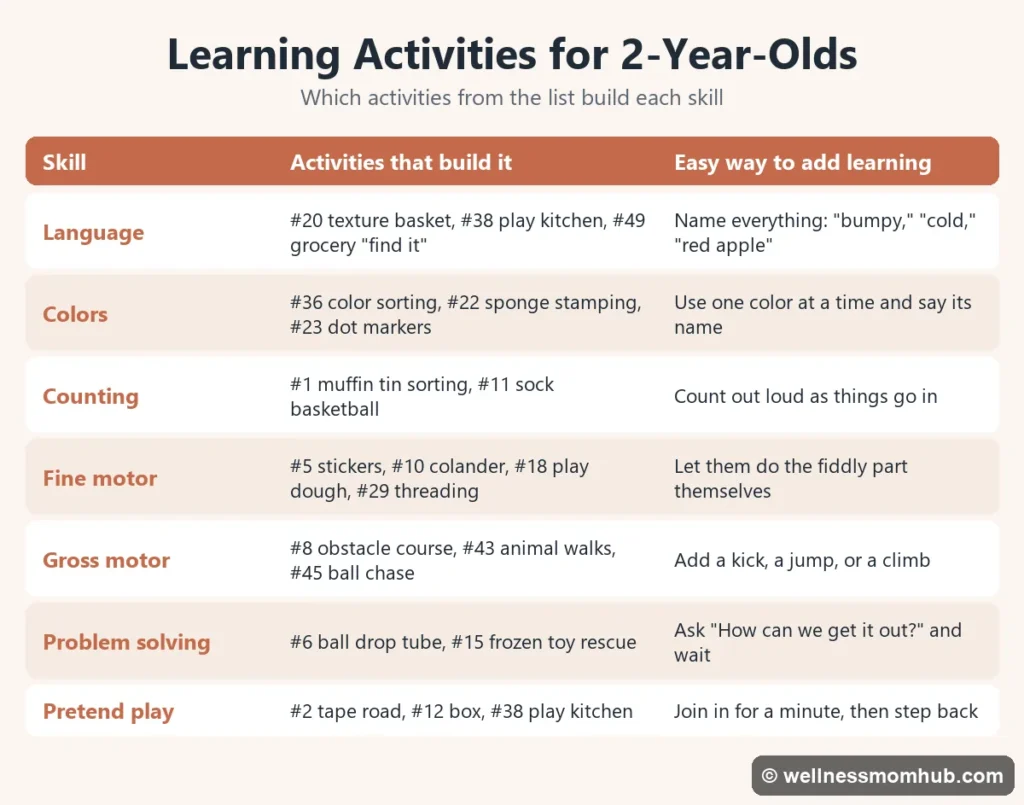
You don’t need flashcards or worksheets to teach a two-year-old. Everyday play builds the skills that matter at this age. By 2, the CDC’s milestones include saying two words together, pointing to body parts and things in a book, kicking a ball, and using a spoon (CDC, Milestones by 2 Years). These activities practice exactly that kind of thing.
| Skill | Activities that build it | Easy way to add learning |
|---|---|---|
| Language and new words | #20 texture basket, #38 play kitchen, #49 grocery “find it” | Name everything: “bumpy,” “cold,” “red apple” |
| Colors | #36 color sorting, #22 sponge stamping, #23 dot markers | Use one color at a time and say its name |
| Counting | #1 muffin tin sorting, #11 sock basketball | Count out loud as things go in: “one, two, three” |
| Fine motor (hands and fingers) | #5 stickers, #10 colander, #18 play dough, #29 threading | Let them do the fiddly part themselves |
| Gross motor (big movements) | #8 obstacle course, #43 animal walks, #45 ball chase | Add a kick, a jump, or a climb |
| Problem solving | #6 ball drop tube, #15 frozen toy rescue | Ask “How can we get it out?” and wait |
| Pretend play | #2 tape road, #12 box, #38 play kitchen | Join in for a minute, then step back |
If you have questions about how your child is developing, your pediatrician is the right person to ask. The CDC’s free milestone checklist is a good starting point for that conversation. For more hand-skill ideas by age, see our fine motor activities for toddlers.
Choosing by interest, not by boy or girl
Every activity here works for any two-year-old. Toddlers’ interests vary far more from child to child than between boys and girls. If your child is into vehicles, start with #2 (tape road), #12 (box car), and #35 (toy car wash). Animal lovers tend to love #43 (animal walks) and #32 (cotton ball sheep). Kids who never stop moving do best with #8, #41, and #44. Follow the interest, not the label.
When your toddler is closer to 2½
Around two and a half, most toddlers can handle a little more: two-step instructions, longer pretend play, and early “rules.” Try the flashlight hunt (#13), freeze dance (#42), color sorting (#36), and simple crafts (#28–33) with less help from you. When the whole list starts to feel too easy, move on to our activities for 3-year-olds.
Toddler-safe swaps for common activity supplies
 Save
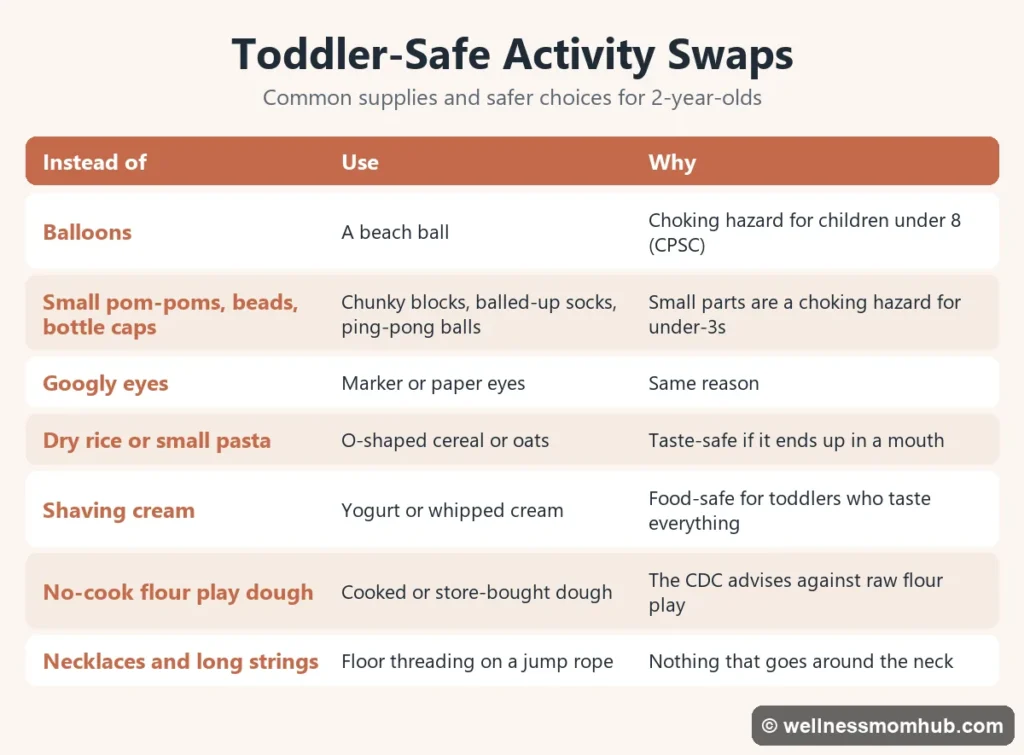
| Instead of… | Use… | Why |
|---|---|---|
| Balloons | A beach ball | Balloons are a choking hazard for children under 8 (CPSC) |
| Small pom-poms, beads, bottle caps | Chunky blocks, balled-up socks, ping-pong balls | Small parts are a choking hazard for under-3s |
| Googly eyes | Marker or paper eyes | Same reason |
| Dry rice or small pasta | O-shaped cereal or oats | Taste-safe if it ends up in a mouth |
| Shaving cream | Yogurt or whipped cream | Food-safe for toddlers who taste everything |
| No-cook flour play dough | Cooked or store-bought dough | The CDC advises against raw flour play |
| Necklaces and long strings | Floor threading on a jump rope | Nothing that goes around the neck |
A sample day: how the 50 ideas fit together
Fifty ideas only help if you know which one to reach for at 4:30 on a Tuesday. This is how the list maps onto an ordinary day at home with a two-year-old. Treat the times as a rough shape, not a timetable: shift everything around your child’s wake-up and nap.
| Time of day | What your toddler needs | Reach for |
|---|---|---|
| Early morning, while you make breakfast | Something to do right next to you | #4 “yes” cupboard, #37 board book basket |
| Mid-morning | Big movement while energy is highest | #8 obstacle course, #42 freeze dance, or #50 nature bucket walk |
| After the morning snack | A longer stretch of focused play | #14 cereal bin, #17 water pouring, #15 frozen toy rescue |
| Late morning | A change of scene before lunch | #48 library story time, #49 grocery “find it,” #47 puddle stomping |
| Straight after nap | Quiet, seated time while they wake up | #23 dot markers, #26 crayon roll, #36 color sorting |
| Late afternoon slump | Fresh air or silly movement | #41 bubble chasing, #43 animal walks, #45 ball roll and chase |
| While you cook dinner | Pretend play near you | #38 play kitchen orders, #2 tape road, #40 kitchen band |
| After dinner | Winding down | #37 board books, #20 texture basket |
Two patterns make this work. Put the messy, high-focus activities (sensory bins, painting) in the morning, when you have the most patience for cleanup. Keep the zero-prep ideas for the hours when you have the least. Most two-year-olds still nap once a day, so if yours has dropped the nap, slot a quiet activity and a book in where the nap used to be.
The four zero-effort activities for really hard days
When you have nothing left, rely on the four ideas that need no prep and no participation from you: the “yes” cupboard (#4), sticker books (#34), a cardboard box (#12), and the board book basket (#37). Keep those four permanently stocked and you always have a move. If you’re running on empty more days than not, our guide to easing mom stress has practical ways to lighten the load.
To fit these into a real day, the toddler schedule has sample daily schedules for ages 1, 2 and 3, and the free weekly activity planner template spreads ideas across the week so you plan once instead of every morning.
Activities for 2-year-olds FAQ
What can I do with my 2 year old all day at home?
Rotate short activities instead of hunting for one long one. Line up a sensory bin, an art setup, a movement game, and a screen-free fallback, and swap as soon as interest fades. A rotation of short wins beats one big plan.
What are good learning activities for 2 year olds?
Everyday play is the best learning at two: sorting by color, counting things into a muffin tin, naming textures, play dough for hand strength, and pretend play with a play kitchen. Name things out loud as you play. You don’t need worksheets or flashcards.
What should I teach my 2 year old at home?
Focus on talking, playing, and doing things together: new words, naming colors and body parts, simple turn-taking, and helping with small jobs like putting toys in a basket. The CDC’s milestones by 2 years are a helpful guide to what most children are working on.
How long can a 2 year old focus on one activity?
Usually just a few minutes, and longer when they’re really interested. Switching activities often is normal at this age. Plan a rotation rather than expecting one activity to last.
How do I entertain a 2 year old without screen time?
Have screen-free options ready before you need them: a sticker book, a sorting activity, and a pretend-play prop within reach. Setting up the next activity while the current one is still going keeps the momentum.
What are the best low-mess activities for 2 year olds?
Muffin tin sorting, the “yes” cupboard, colander and pipe cleaners, the texture basket, board books, and dot markers. They stay contained and clean up in a minute or two.
Grab the free printable idea cards
Keep quick ideas on the fridge with the free Boredom Buster cards, so you can pull one at random when your brain is fried. No email required. There’s a whole free printables library if you want more.
Not quite two yet? See our activities for 1-year-olds. For bigger outings and long weekends, try summer activities for kids.
In December, try our Christmas crafts for toddlers: torn-paper trees, cotton ball snowmen and handprint wreaths that 2-year-olds can do themselves.
Early toddler or older toddler? Our guide to what age is a toddler explains the 1 to 2 and 2 to 3 stages, with CDC milestones and a free printable chart.
Shopping for a birthday or Christmas? See our gifts for 2 year olds, sorted by the same skills, with the age on every box.
If your 2-year-old is showing interest in the potty, our free potty training chart printable makes each try something they can see and celebrate.