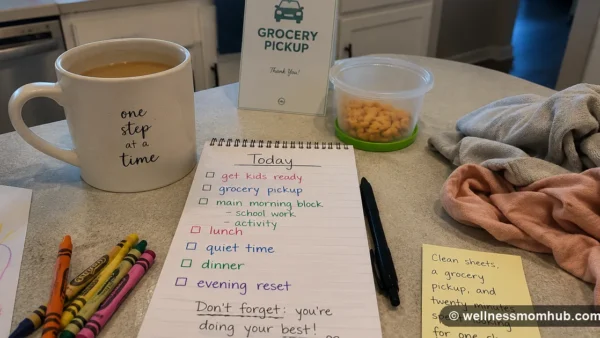
Mom stress often comes from carrying too many family details at once: meals, appointments, school messages, childcare, housework, work deadlines, and the constant question of what everyone needs next. The most realistic way to cope is to reduce decisions, share full responsibilities, and decide what does not need to happen today.
If you are reading this with one eye on your phone and one ear waiting for someone to call your name, you are in the right place.
I am not interested in a perfect routine that only works on quiet mornings. I want fewer moving parts, a backup plan for the bad days, and a place to put the thoughts that keep circling while I am reheating the same coffee.
This article covers everyday household pressure and practical family routines only. It is not medical or mental-health advice; follow your provider for concerns in those areas.
What Is Mom Stress?
Mom stress is the everyday pressure of managing too many overlapping family responsibilities. It includes the jobs everyone can see and the planning work that usually stays in one person’s head.
The individual tasks can look almost laughably small:
- Refill the diaper bag.
- Reply to the preschool message.
- Add milk to the grocery list.
- Find a birthday gift.
- Confirm tomorrow’s pickup.
- Remember pajama day.
Then they all land on the same Tuesday.
Doing the task is often the easy part. The tiring part is noticing it, remembering it, planning it, assigning it, and checking that it happened.
You can be sitting on the couch while part of your brain is still counting clean socks and wondering whether the daycare payment went through.
What Causes Moms to Feel So Overwhelmed?
The pressure usually builds when one person becomes the default parent for most of the family’s planning and unfinished jobs. Packed schedules, childcare costs, work, and the pressure to keep ordinary days running smoothly add more weight.
1. Being the default person for every detail
The default parent is the person everyone asks first, even when another capable adult is standing three feet away.
You know where the extra wipes are, when the preschool form is due, and which cup has somehow become unacceptable since yesterday.
That information takes up space.
2. Making decisions all day
Breakfast, outfits, daycare pickup, snacks, dinner, errands, bath time, and tomorrow’s schedule create a steady stream of choices.
None is especially complicated. By late afternoon, I am simply tired of choosing.
3. Getting help without giving up the management
There is a big difference between someone doing a task and someone owning it.
When you notice the laundry, ask for help, explain what needs washing, and check whether it was finished, you are still managing the laundry.
Skip this: vague requests like “Can you help more?” A specific handoff has a much better chance of removing work.
4. Building routines for imaginary perfect days
A routine that only works when everyone wakes up cheerful, the refrigerator is stocked, and nobody spills yogurt on the way out will not survive a normal week.
Family systems need room for late starts, missing backpacks, traffic, and cereal-for-dinner nights.
I do not want a color-coded system that becomes one more thing I have to maintain. A short checklist on the refrigerator wins. If you are rebuilding yours, start with realistic mom routines rather than an aspirational schedule.
5. Leaving no buffer between commitments
A morning appointment, daycare pickup, grocery run, and family visit may look fine on a calendar.
Then someone refuses shoes.
I count transition time as part of the plan. Getting into the car is part of the outing, and getting everyone back out counts too.
6. Carrying financial and childcare logistics
Groceries, school supplies, activity fees, childcare arrangements, and household bills come with their own trail of small decisions.
You compare options, remember deadlines, arrange care, and move work around. The item itself may be cheap. The planning still takes time.
7. Feeling pressure to make ordinary days special
Social media can make a regular Tuesday look as though it needs themed snacks, a craft, a spotless playroom, and matching seasonal pajamas.
No.
Sometimes the activity is crayons at the kitchen table while dinner cooks. Sometimes it is a cardboard box. If you want a list you can pull from without planning anything, these easy indoor activities for toddlers are built for ordinary days.
A Quick Reset for an Overwhelming Day
The fastest practical reset is to find the one thing making the next hour harder and make it smaller. Do not fix the week while standing in a messy kitchen at 4:45 p.m.
I use the free Mom Stress Reset Printable when everything feels equally urgent. It has three places to write: what must happen, what someone else can own, and what can wait.
Skip filling every box neatly. Scribble on it. Cross things out. That is the point.
| When the day feels like this | Do this first | Let this wait |
|---|---|---|
| Everyone needs something at once | Write the next three tasks | Anything not needed today |
| Dinner has no plan | Use a backup meal | Trying a new recipe |
| The house looks overwhelming | Clear one visible surface for 10 minutes | Whole-house cleaning |
| The calendar is too full | Cancel or shorten one optional plan | Writing a long explanation |
| You are carrying every reminder | Assign one full recurring responsibility | Building the perfect system |
| One errand is wrecking the afternoon | Use curbside pickup or postpone it | Combining five errands |
| The morning started badly | Use the minimum routine | Catching up on skipped tasks |
10 Realistic Ways to Lighten the Load
The most useful changes remove work instead of creating another project. Pick one or two ideas that fit this week; ten new habits at once would become their own problem.
1. Write down only the next three things
Pick three actions that will make the next part of the day work.
Do not begin with a master list covering the house, your inbox, birthday gifts, and every appointment through June.
A useful list might be:
- Pack the preschool bag.
- Move the laundry to the dryer.
- Decide what dinner is.
That is enough.
Why it works in real life: a short list gives you somewhere to start without turning planning into another hour-long task.
2. Hand off ownership, not favors
Give another adult one recurring responsibility from start to finish.
Instead of saying, “Can you help with lunch?” say:
You own school lunches on weeknights, including checking supplies, making them, and washing the containers.
Full ownership means the other person handles:
- Noticing the task.
- Planning what it needs.
- Doing it.
- Handling the follow-up.
The first few attempts may be different from your way. Let them be different.
Skip this: micromanaging the handoff. That leaves you carrying the job while somebody else technically completes it.
Why it works in real life: the reminder and follow-up leave your head along with the physical task.
3. Make a list of default dinners
Write down five to seven meals your family already eats and that you can make with very little thought.
- Tacos or quesadillas.
- Pasta with a familiar sauce.
- Rotisserie chicken, bagged salad, and rolls.
- Breakfast for dinner.
- Frozen pizza with fruit.
- Grilled cheese and canned soup.
- Snack plates made from whatever is left.
These meals have one job: answer the dinner question. More ideas live in family meals.
Skip this: a rotating four-week meal calendar, unless you enjoy maintaining one. Wednesday may still end in toast, and that is fine.
Why it works in real life: familiar meals remove one decision during the loudest part of the day.
4. Decide what counts on a minimum day
A minimum day is the smallest version of the routine that keeps things moving.
It might mean:
- Everyone gets fed.
- Essential bags are packed.
- One kitchen surface is usable.
- Tomorrow’s first commitment is checked.
Done.
The minimum changes with work, childcare, your children’s ages, and whatever chaos walked in that morning.
Why it works in real life: a hard day no longer has to meet the standards of an easy one.
5. Give everyday items one landing spot
Pick one place for the things that cause repeated searching:
- Keys
- School papers
- Shoes
- Backpacks
- Library books
- Water bottles
- Diaper bags
You do not need custom storage. A basket, hook, or tray near the door will do, and there are more ideas like it in home organization.
Put it where bags actually land, not where the basket looks best in a photo. The spot may still look messy. At least the backpack is there.
Why it works in real life: you spend less time searching the house during the worst possible five minutes.
6. Put recurring responsibilities on a shared calendar
Add trash night, daycare payments, library day, activity pickups, school events, and household orders to a calendar everyone can see.
Use a shared digital calendar, a paper calendar, or the whiteboard already hanging in your kitchen.
Skip this: downloading another planning app, unless the people in your house will actually open it.
Add a name beside each responsibility. “Library books due” can still sound like your job. “Chris returns library books” is clearer.
Why it works in real life: the calendar does the reminding, so one person does not have to become the household notification system.
7. Use one-sentence boundaries
A boundary does not need a speech.
- “We cannot add another activity this month.”
- “That time does not work for our family.”
- “I cannot volunteer for the school event this week.”
- “We are leaving Saturday open.”
- “I need to check our calendar first.”
Then stop talking.
The longer the explanation gets, the easier it is to start negotiating against yourself.
Why it works in real life: a prepared sentence keeps guilt from volunteering your future time.
8. Keep one low-effort activity ready
Have one activity you can pull out when you need 15 minutes to finish dinner, answer an email, or clear the kitchen.
- A sticker book kept out of sight.
- A reusable drawing tablet.
- Painter’s tape and toy cars.
- A bin of large blocks.
- A familiar show saved for rough afternoons.
Skip this: anything with dozens of tiny pieces, paint that creates a second cleanup, or instructions longer than the activity lasts. These low-prep activities for preschoolers are tagged by prep time and mess level if you want a bigger list to pull from.
Why it works in real life: you do not have to invent entertainment while someone asks for a snack and the pasta water boils over.
9. Reset one area instead of cleaning everything
Choose the space that will make tomorrow morning less annoying.
- The kitchen counter.
- The dining table.
- The entryway.
- The living-room floor.
Set a timer for 10 or 15 minutes. Stop when it rings.
Skip this: following one stray sock into another room and accidentally beginning to reorganize a closet. That road has no end.
Why it works in real life: one usable space gives you a visible result without taking the entire evening.
10. Replace one errand with an easier option
Find the errand creating the biggest bottleneck.
- Use grocery or curbside pickup.
- Add household basics to a recurring order.
- Ask your partner to own the errand.
- Move it to another day.
- Decide the item can wait.
I use pickup for boring essentials, not products I want to choose myself.
Skip this: the “efficient” option when its pickup window cuts through preschool dismissal or creates another deadline.
Why it works in real life: removing one errand also removes loading the car, unloading the car, and finding the shoe that disappeared between those two events.
How to Talk to Your Partner About the Mental Load
The clearest way to discuss the mental load is to name the work you are carrying and ask your partner to own one recurring responsibility. A general request for more help can leave both people unsure about what should change.
Start with what you currently manage:
I am planning dinner, tracking school messages, packing bags, and handling the evening routine. I cannot keep owning all four.
Then ask for one concrete change:
Starting this week, can you own the evening routine on Monday, Wednesday, and Friday, including supplies, cleanup, and getting everything ready for the next night?
Keep the first conversation narrow. Trying to redistribute the entire household in one sitting can become a courtroom recap of every dish washed since 2019.
A short weekly check-in can cover:
- What appointments and school events are coming up?
- Who owns each pickup, errand, or deadline?
- What supplies are running low?
- Which meals need a plan?
- What can we cancel?
Skip this: holding the check-in when both of you are already irritated and somebody is yelling from the bathroom. Put 10 minutes on the calendar instead.
The goal is shared ownership. Nobody should need to wait for instructions before doing the job they own.
What to Do When Your Family Routine Falls Apart
When the routine falls apart, switch to the smallest workable version of the day. Keep what truly has to happen, make one thing easier, and move the rest.
Ask:
- What still has to happen?
- What can become easier?
- What can move?
A planned dinner can become sandwiches. A full house reset can become clearing the table. A long outing can become 20 minutes in the backyard. A complicated grocery trip can become tomorrow’s problem.
I do not spend the rest of a hard day trying to force it back into the morning’s plan. That usually creates a bad day plus an argument with the clock.
A realistic routine needs an exit ramp. It also helps to have a short list of things that refill you, which is the whole point of realistic self-care for moms.
Mom Stress FAQs
These quick answers cover common questions about everyday parenting pressure, the mental load, household responsibilities, and family routines. Each answer stays focused on practical home logistics rather than medical or mental-health advice.
Why am I so stressed as a mom?
A common reason is the mental load: appointments, meals, school messages, supplies, schedules, and everyone’s next need. The pressure can grow when one person is the default parent, household tasks are not fully shared, and there is little buffer between work, childcare, and home responsibilities.
What are quick ways to handle mom stress during a busy day?
Reduce the next hour to three necessary tasks, use the easiest available meal, and postpone one nonessential job. Pick the pressure point causing the most trouble right now and make that one thing easier.
How can I talk to my partner about mom stress?
Name the responsibilities you currently own and ask your partner to take full ownership of one recurring task. Include planning, supplies, reminders, completion, and follow-up so you are not still managing it from the sidelines.
How can I reduce the mental load at home?
Move family information out of your head and into shared systems such as a calendar, grocery list, meal plan, or entryway drop zone. Put a name beside each recurring responsibility so the system does not quietly become another thing only you maintain.
What should be included on a mom stress checklist?
Use three buckets: what must happen today, what someone else can own, and what can wait. Keep it short. A checklist that takes 20 minutes to complete will not help at 4:45 p.m.
How can a stay-at-home mom make the day feel more manageable?
Separate childcare from the extra household jobs you are trying to complete at the same time. Choose a minimum-day routine, keep one low-effort activity ready, and transfer at least one recurring evening or weekend responsibility to another adult when that is possible.
How can a working mom make evenings less overwhelming?
Use one shared calendar for work, daycare, school, and family commitments, then assign a person to each task. Default meals, grocery pickup, packed bags, and fewer back-to-back plans can remove several decisions from the end of the workday.
Start With One Thing You Can Stop Carrying
You do not need to reorganize your entire family life today. Choose one thing you can stop carrying.
Pick one dinner decision, reminder, errand, or household responsibility that no longer needs to live only in your head.
Download the free Mom Stress Reset Printable and use it to separate today’s essentials from the jobs that can be shared or moved. No email required.
Scribble on it. Cross something out. Then stop. If you want more like it, the free printables library is open, and there is more on the routine side in mom routines.
Once the load is lighter, wellness for moms covers the routines that keep it that way.
A loose daily structure takes some of this off your plate too. This stay-at-home mom schedule plans for the days that fall apart instead of pretending they will not.