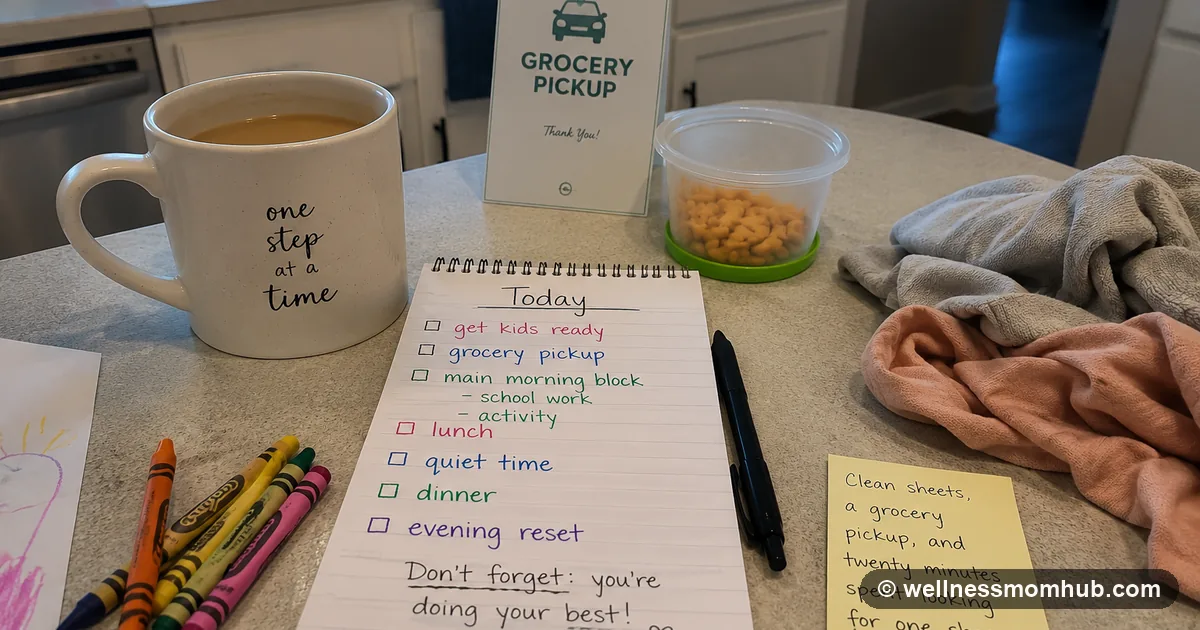
A stay-at-home mom schedule works best when it uses a few dependable anchors instead of assigning every task an exact time. Build the day around getting ready, a main morning block, lunch, quieter afternoon time, dinner, and a short evening reset.
I learned that after making several beautiful schedules that barely survived breakfast. My toddler did not care what the color-coded sticky note said, and I was tired of feeling behind before I had finished my coffee.
The schedule below is specific enough to guide the day. It also leaves room for the kind of Tuesday that suddenly requires clean sheets, a grocery pickup, and twenty minutes spent looking for one shoe.
How to Build a Stay at Home Mom Schedule With Five Daily Anchors
The best stay at home mom schedule uses five daily anchors that stay in roughly the same order even when the clock changes. They give the day a shape without turning breakfast and errands into appointments you can somehow be late for.
1. Open the house. Get dressed, open the curtains, handle breakfast, and complete one tiny reset such as unloading the dishwasher or starting a load of laundry.
Why it works: I begin with a visible starting point instead of wandering between five half-finished jobs.
2. Do the main activity early. Use the morning for library storytime, a playground trip, grocery pickup, errands, backyard time, or a simple activity at home.
Why it works: I am far more likely to leave the house before lunch dishes and the afternoon slump show up.
3. Reset around lunch. Serve lunch, clear the main eating area, and decide what genuinely needs to happen during the afternoon.
Why it works: Lunch becomes a midpoint instead of another task dropped on top of the morning mess.
4. Protect one quieter block. Use your child’s usual quiet time or independent play for one chosen task or an actual break.
Why it works: I do better when I decide beforehand. Otherwise I can spend half the block choosing between laundry, email, and sitting down.
5. Close the day. Do a short pickup, prepare one thing for tomorrow, and hand off responsibilities when another adult is available.
Why it works: A small evening routine keeps the whole house from becoming tomorrow morning’s problem.
Skip the urge to assign each anchor an exact start time. I tried that. One late breakfast pushed everything back, and then I spent the rest of the day annoyed at a schedule I had made myself.
Some days the main activity is an outing. Other days it is a bowl of water and a stack of plastic cups at the kitchen counter. That still counts.
A SAHM Schedule Should Use Priorities, Not an Endless To-Do List
A SAHM schedule becomes more manageable when you choose a few daily priorities and match them to the times your household usually works best. Start with fixed commitments, add four priorities, and leave buffer space between activities.
1. Write down the fixed parts. List preschool drop-off, appointments, regular classes, work calls, pickup times, and commitments that cannot move.
Why it works: I can see the actual open time instead of planning for a day I do not have.
2. Pick four daily priorities. One child-focused plan, one household job, one administrative task, and one thing for yourself. For example: go outside after breakfast, wash and dry one load of clothes, schedule an appointment, and drink coffee while it is still recognizable as coffee.
Why it works: Four categories keep every unfinished task from pretending it is urgent.
3. Match the hardest task to your best window. Notice when your household is usually easiest to manage, and use that pocket for paperwork, phone calls, or meal planning.
Why it works: I stopped saving administrative jobs for the exact hour when everyone wanted something from me.
4. Leave buffer space. Do not place every activity back-to-back. Leave room for shoes, bathroom stops, snack requests, loading the stroller, and finding the water bottle that was definitely here five minutes ago.
Why it works: Transitions often take longer than the activity in my house.
5. Review the routine once a week. Keep what helped and remove what created extra work.
Why it works: The routine can change before it becomes an old sheet of paper nobody looks at.
Skip the giant daily to-do list. It made me feel productive while I was writing it and terrible while I was ignoring it.
Build a Stay at Home Mom Routine Around Flexible Time Blocks
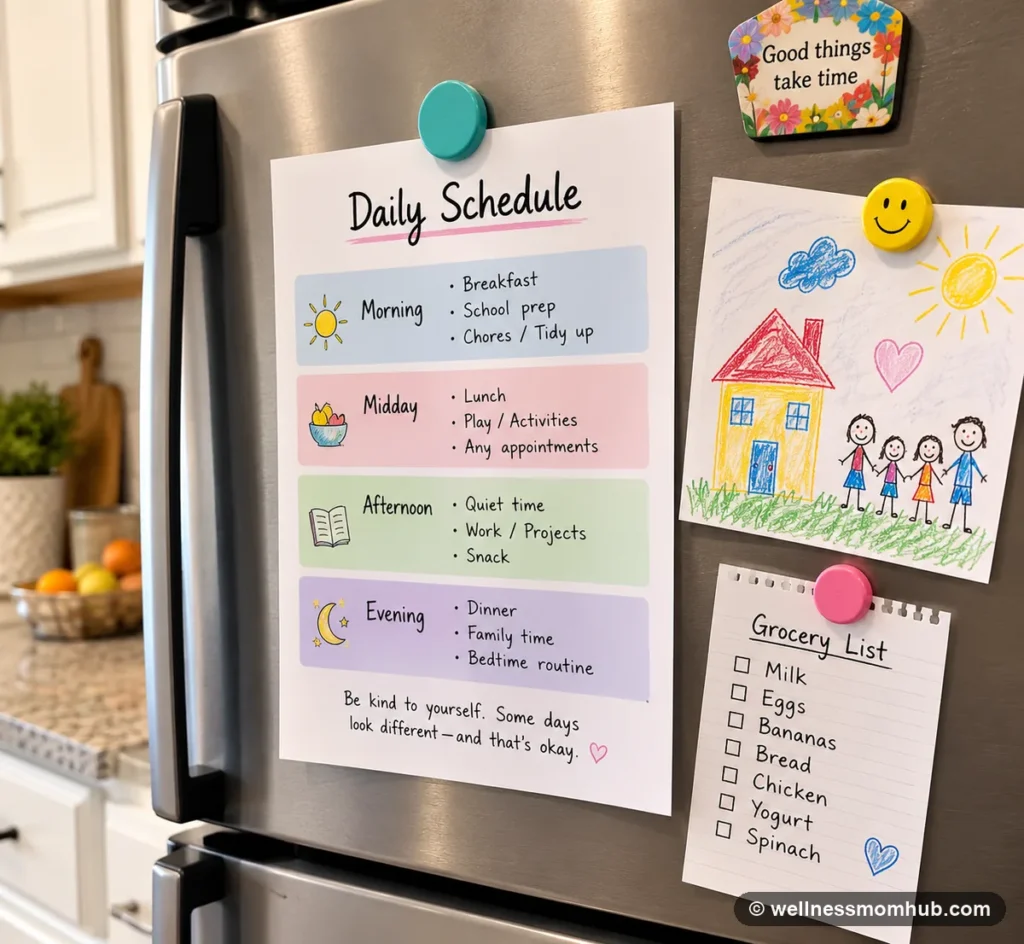
A stay-at-home mom routine works better when it gives you structure without making every minute feel scheduled. Instead of planning hour by hour, divide the day into morning, midday, afternoon, and evening, then decide what to tackle based on how the day is actually going.
If your toddler skips a nap or an unexpected errand comes up, it is much easier to pick up where you left off, because you are returning to a time block rather than catching up on a schedule that has already fallen apart.
Morning block
Focus on breakfast, getting dressed, one household reset, and the day’s main outing or activity. Keep this block simple enough that you can still use it after a late start.
Midday block
Handle lunch, clear the eating area, and set up one quieter activity. This is also a good point to admit that the original afternoon plan is no longer happening.
Afternoon block
Choose one household task, administrative job, outside activity, or errand. Do not automatically drag every missed morning task into the afternoon.
Evening block
Move through dinner, basic cleanup, family routines, and one preparation for tomorrow. The house can still look lived in. Mine usually does.
Skip creating a separate block for every chore. “Laundry from 9:10 to 9:25” looked organized on paper and had absolutely no relationship with my actual laundry.
My SAHM Daily Schedule at a Glance
A SAHM daily schedule can use broad time ranges while leaving the activities inside each range flexible. This sample stay at home mom schedule is built for a weekday at home with a toddler or preschooler, and every block can slide earlier or later.
| Approximate time | Main block | What I usually focus on | Low-energy fallback |
|---|---|---|---|
| 6:30-8:30 a.m. | Open the day | Breakfast, getting dressed, dishwasher, one laundry load | Breakfast and clothes only |
| 8:30-11:00 a.m. | Main activity | Errands, playground, library, backyard, or home activity | Short walk or simple indoor play |
| 11:00 a.m.-1:00 p.m. | Lunch reset | Lunch, cleanup, quick pickup, prepare quiet activity | Easy lunch and leave dishes soaking |
| 1:00-3:00 p.m. | Quieter block | One household task, admin job, independent play, or break | Sit down and choose one five-minute task |
| 3:00-5:00 p.m. | Afternoon bridge | Snack, outdoor time, free play, or dinner prep | Screen time and the easiest dinner |
| 5:00-7:30 p.m. | Evening close | Dinner, cleanup, family routine, tomorrow setup | Clear one surface and stop |
The times are loose on purpose. A grocery pickup that should take fifteen minutes can eat the whole morning once somebody needs a snack, a bathroom, and a second trip back to the car.
Do not copy the sample line by line if your mornings start at 5:30 or your child attends preschool three days a week. Move the blocks. Keep the order that helps.
What to Do as a Stay at Home Mom When Everything Feels Urgent
When deciding what to do as a stay at home mom, focus first on direct care, basic household function, one future-facing task, and one personal need. You do not need to clean, entertain, organize, cook from scratch, answer messages, and make a core memory during the same two-hour window.
I sort the day into four buckets.
1. Handle what keeps today moving. Meals, getting dressed, necessary transportation, scheduled commitments, and enough cleanup to use the space.
Why it works: I stop reorganizing a closet while the kitchen sink is blocking dinner.
2. Choose one household job. One laundry load, one vacuumed area, the bathroom sink, a grocery order, or the kitchen table.
Why it works: One finished task is more useful than six rooms I started.
3. Complete one future-facing task. Fill out a form, check the family calendar, schedule an appointment, prepare a preschool bag, or add items to the grocery list.
Why it works: A ten-minute task today can prevent tomorrow morning from becoming a scavenger hunt.
4. Include one thing that is not housework. Sit down during independent play, call a friend, read, shower without also cleaning the tub, or take your drink outside.
Why it works: Being home does not mean every open minute belongs to the house.
Skip choosing a job with no clear ending. “Organize the playroom” can swallow an afternoon. “Put all the blocks back in the blue bin” has a finish line.
Some days I manage all four buckets. On other days the list is lunch, bathroom trips, and getting everyone to dinner. The schedule is supposed to help. It does not get to grade me.
If the load itself is the heavy part rather than the tasks, these ways to lighten the mental load pair well with this schedule.
A Toddler Schedule for Ordinary Home Days
Life with a toddler goes more smoothly when the day follows a familiar rhythm instead of a strict schedule. We keep the same general order, getting ready, active play, meals, quiet time, and the bedtime routine, without worrying about starting everything at the exact same minute.
1. Morning start. Breakfast, getting dressed, and one simple household reset.
Why it works: The day has a recognizable beginning before toys spread into every room.
2. Active morning block. Go outside, run an errand, visit the playground, attend storytime, or set up one easy activity at home.
Why it works: I use the part of the day when leaving the house still feels possible.
3. Lunch and cleanup. Keep lunch logistics simple, then clear only what you need for the afternoon.
Why it works: A full kitchen cleaning can wait when everyone needs a change of pace.
4. Quiet activity block. Books, blocks, reusable stickers, coloring supplies, or another familiar activity.
Why it works: Having two or three default options saves me from inventing entertainment at 1:30 p.m.
5. Afternoon bridge. A snack, outdoor time, music, a small chore together, free play, or screen time to get from the quieter block to dinner.
Why it works: The hardest part of my day is usually the long stretch before dinner.
6. Evening routine. Dinner, basic cleanup, and your family’s normal bedtime logistics.
Why it works: Repeating the same general order means I do not have to redesign the evening every night.
Skip rotating through a huge collection of activities. I tried keeping too many choices ready, and all it gave me was more stuff to pick up. If you want ideas that hold longer than five minutes, 45 toddler activities at home are sorted by energy level and mess.
This is a lifestyle routine, not sleep or developmental advice. Follow your pediatrician or provider for individual concerns. If screen time is part of your afternoon bridge, the American Academy of Pediatrics family media guidance is a reasonable place to set your own rules.
Use This Toddler Schedule Template to Plan Your Actual Day
A toddler schedule template should give you editable blocks rather than a page full of fixed times. Start with nonnegotiable commitments, add one main activity, and create a fallback for the part of the day most likely to go sideways.
1. Add fixed commitments. Preschool, childcare, appointments, classes, work calls, and recurring errands.
Why it works: The template starts with your real week instead of a generic internet schedule.
2. Circle the hardest time of day. Mark the block that most often falls apart, such as getting out the door or the hour before dinner.
Why it works: The schedule supports the pressure point instead of decorating the easy hours.
3. Add one main plan. One outing, home activity, errand, or household task.
Why it works: One plan gives the day direction without turning it into a field trip itinerary.
4. Write a minimum-day option. The easiest lunch, the quickest familiar activity, and the household task you are willing to skip.
Why it works: The fallback is already decided when the original plan stops working.
5. Test it for one week. Use the same template for several ordinary days, then cross out what does not fit.
Why it works: A messy page with honest edits is more useful than a perfect schedule you never use.
Skip laminating the first version. Test it with a pencil. Mine needed arrows, crossed-out blocks, and one entire section moved before it was useful.
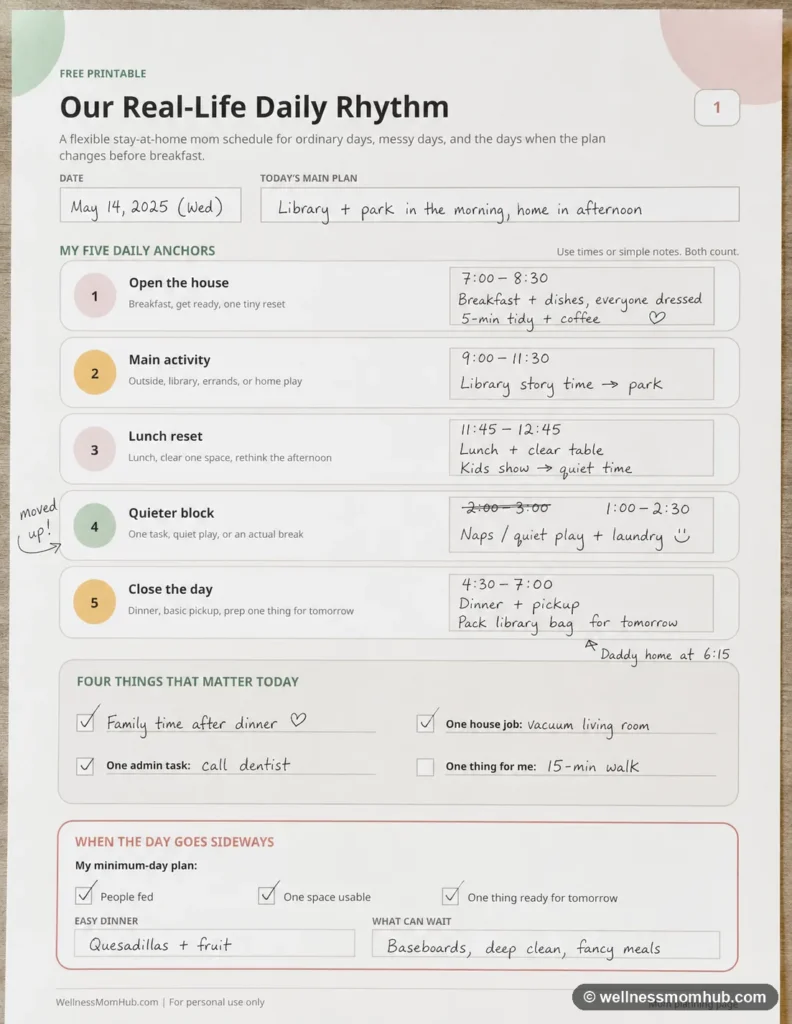
I made a printable because I am much more likely to use an idea when I can stick it on the fridge than when I am trying to remember where I saw it three days ago. Download the free editable stay-at-home mom schedule printable, print it at home, and keep it somewhere easy to spot.
A Daily Routine for 2 Year Old Family Life
A daily routine for 2 year old family life can use the same broad sequence each day while changing the activity inside each block. The goal is to make household logistics easier, not to prescribe what every 2-year-old should do at a particular hour.
1. Start with breakfast and getting ready. Keep the first block focused on food, clothes, basic care, and opening the main living space.
Why it works: I am less likely to begin cleaning random cabinets before everyone is ready.
2. Use the morning for an outing or errands. Playground, stroller walk, grocery pickup, storytime, or active play at home.
Why it works: The main plan happens before the afternoon becomes crowded with smaller tasks.
3. Keep lunch predictable. Repeat meals, leftovers, or another low-decision option that already works.
Why it works: Noon is not when I want to invent a completely new family menu. If you need a rotation, 60 toddler lunch ideas covers the repeatable ones.
4. Prepare one quiet activity. Books, chunky puzzles, coloring supplies, or another familiar setup.
Why it works: I can begin my own task without searching the entire house for activity pieces.
5. Plan the pre-dinner hour. Choose in advance between outside time, a simple show, music, helping with a small household task, or playing near the kitchen.
Why it works: Dinner preparation is easier when the afternoon bridge is not a daily surprise.
6. Reset only what helps tomorrow. Clothes, the diaper or bathroom basket, the table, or the bag needed in the morning.
Why it works: I end with one useful setup instead of attempting a full-house reset at night.
Skip buying a new bin or activity kit every time the routine feels stale. Moving the same crayons to the kitchen table has saved more afternoons here than anything fancy.
Three Schedules for 2 Year Olds: Home, Errand, and Minimum Days
Useful schedules for 2 year olds can change depending on whether the family is staying home, going out, or simply getting through a difficult day. Keep the same anchors and adjust how much you expect from each block.
1. The home-day schedule. Breakfast, one home activity, outdoor time, lunch, quiet play, an afternoon reset, and the evening routine.
Why it works: Staying home still has shape, but I am not required to provide a new activity every hour.
2. The errand-day schedule. Get ready, complete one or two errands, return for lunch, keep the afternoon simple, and skip optional household jobs.
Why it works: I stopped treating errands as if they happened outside the schedule. They are the main activity.
3. The minimum-day schedule. Meals, basic care, one contained activity, and the easiest available dinner. Everything else moves.
Why it works: A smaller plan prevents me from repeatedly failing at the original, much bigger plan.
Skip adding a quick cleaning block after errands. That never worked for us. Coming home, putting away the cold groceries, and sitting on the floor for a minute was much more realistic.
I keep the minimum-day plan visible, because those are the days when I am least interested in opening a planner.
Sample Stay-at-Home Mom Schedule With a Baby
A schedule with a baby should organize repeatable adult and household tasks around the baby’s existing care pattern instead of forcing the day into precise time slots. Use short blocks and choose only one optional task between necessary care periods.
This section covers household logistics only, not infant feeding, sleep, or medical guidance. Follow your pediatrician and your baby’s individual care plan.
1. Morning essentials block. Get yourself something to eat, get dressed if possible, and open the main room for the day.
Why it works: My own basic needs stay visible instead of disappearing behind the household list.
2. One-surface reset. Clear one counter, table, or chair rather than attempting the entire room.
Why it works: One usable surface can make the next part of the day easier.
3. One necessary task. One phone call, laundry load, grocery order, or appointment.
Why it works: The task can be paused and restarted without losing an elaborate setup.
4. Fresh-air or location change. Move to the porch, yard, stroller route, or another room when it fits your day.
Why it works: A simple change of setting can break up a long stretch at home.
5. Evening preparation. Set out one item for tomorrow and decide the easiest dinner plan available.
Why it works: I do not need to solve the next morning while already in it.
Skip tasks that require every piece to stay in place. Sorting an entire closet did not work in this season. Ordering groceries or folding half a basket did.
Sample Stay-at-Home Mom Schedule With a Preschooler
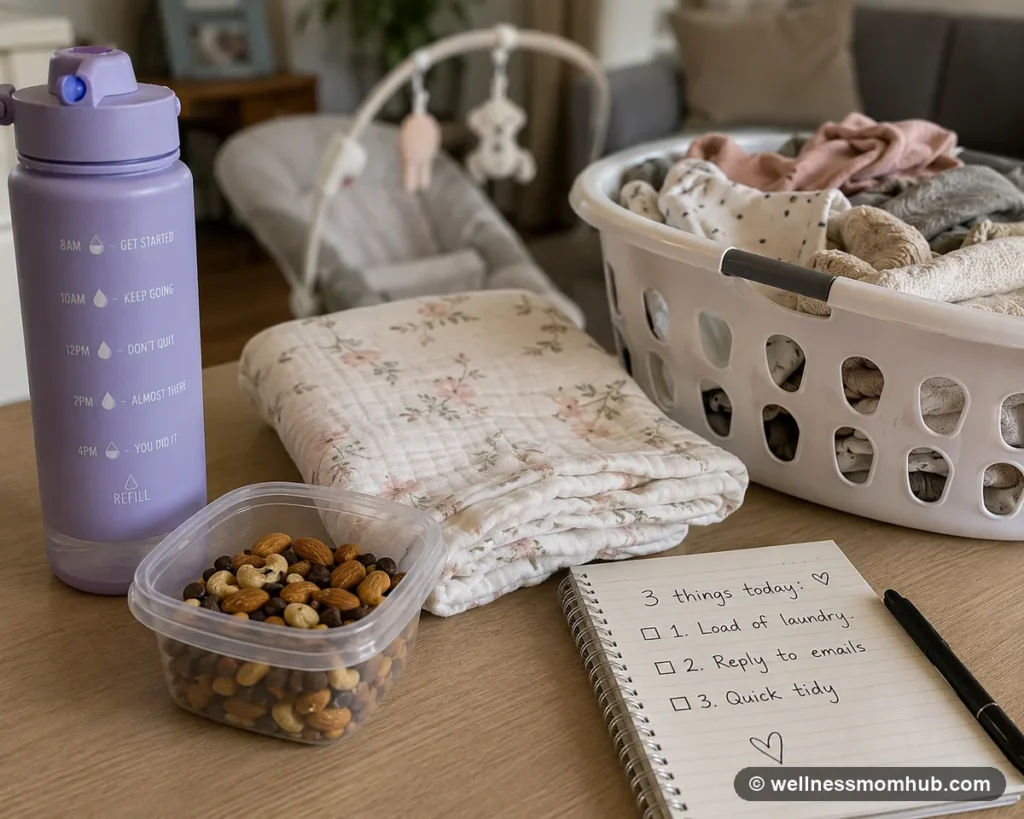
With a preschooler, a simple routine matters more than filling every hour. Start with a predictable morning, plan one main activity, leave time for independent play, and keep the afternoon calm with a familiar routine before dinner.
1. Morning launch. Breakfast, clothes, bags, and the day’s first destination or home activity.
Why it works: Keeping the launch steps together reduces the number of separate reminders I need.
2. Main morning plan. Preschool, errands, an outing, outdoor time, or a planned activity at home.
Why it works: One main plan is enough to give the morning direction.
3. Lunch and shared reset. Clear the table and invite your child to help with one simple household action you already use.
Why it works: Cleanup becomes part of the block instead of a second event I do alone later.
4. Independent activity. Set out a familiar activity while you complete one contained task nearby.
Why it works: Familiar materials require less setup and fewer instructions from me.
5. Afternoon choice. One of outdoor time, a friend visit, screen time, an errand, or free play.
Why it works: Limiting the choices stops me from trying to fit three afternoons into one.
6. Evening close. Dinner, your family’s normal bedtime routine, and one preparation for tomorrow.
Why it works: The day ends with a repeatable order even when the house is still visibly lived in.
Skip turning every household task into a learning activity. Sometimes I need to unload the dishwasher without explaining the forks.
When Your Stay at Home Mom Schedule Falls Apart
When your stay at home mom schedule falls apart, reduce the next part of the day to three essentials: care for the people, prepare the next meal, and make one space usable. Cancel or move everything that does not help with those jobs.
1. Stop trying to catch up. Do not squeeze missed morning tasks into the afternoon.
Why it works: Catch-up mode turns one delayed block into an entire day of rushing.
2. Choose the easiest meal. Leftovers, freezer food, sandwiches, breakfast food, or takeout.
Why it works: Dinner does not need to become the day’s redemption project.
3. Reset one zone. The kitchen table, the main floor path, or the bathroom counter.
Why it works: One functional area is more useful than moving clutter between five rooms.
4. Use a default activity. A familiar toy bin, coloring supplies, books, water play, or a show.
Why it works: I do not need creativity when the original plan is already gone.
5. Prepare one thing for tomorrow. Set out clothes, pack a bag, start the dishwasher, or write tomorrow’s first task on a note.
Why it works: A rough day does not automatically need a difficult sequel.
Skip the heroic recovery plan. I have tried cleaning the kitchen, folding laundry, and preparing tomorrow after a bad day. It usually ended with me tired and still annoyed.
Sometimes the reset is cereal for dinner, a clear path through the living room, and everybody going to bed with the correct stuffed animal.
Stay-at-Home Mom Schedule FAQs
These stay-at-home mom schedule FAQs cover daily priorities, realistic routines, and staying organized when the day changes.
What should a stay-at-home mom do?
A stay-at-home mom should focus on the direct care, household logistics, meals, transportation, appointments, and planning her family actually needs. Beyond that, choose a small number of priorities based on the current season of family life instead of trying to clean, organize, teach, entertain, and cook all day.
What does a realistic SAHM day look like?
A realistic SAHM day includes recurring care tasks, meals, cleanup, play, errands, household work, planning, and plenty of interruptions. Some days follow a dependable rhythm. Other days come down to basic care, easy food, and one usable room.
What do stay-at-home moms do all day?
Stay-at-home moms manage childcare and many visible and behind-the-scenes family tasks, including meals, laundry, transportation, appointments, supplies, calendars, forms, cleanup, and planning what happens next. Much of that work happens in short pieces, because somebody always needs something in the middle of it.
What is a good schedule for a stay-at-home mom?
A good stay at home mom schedule uses a few fixed anchors: getting ready, a main activity, meals, a quieter block, and the evening routine. It also leaves flexible space between them. The schedule should guide the order of the day without requiring every task to begin at an exact time.
How do I stay organized as a stay-at-home mom?
Keep one visible weekly calendar, choose four daily priorities, and group repeated tasks into morning, afternoon, and evening blocks. Add a short meal plan, a basic cleaning schedule, and a written fallback plan so you are not making every decision while someone is asking for a snack.
Download the Editable SAHM Schedule Printable
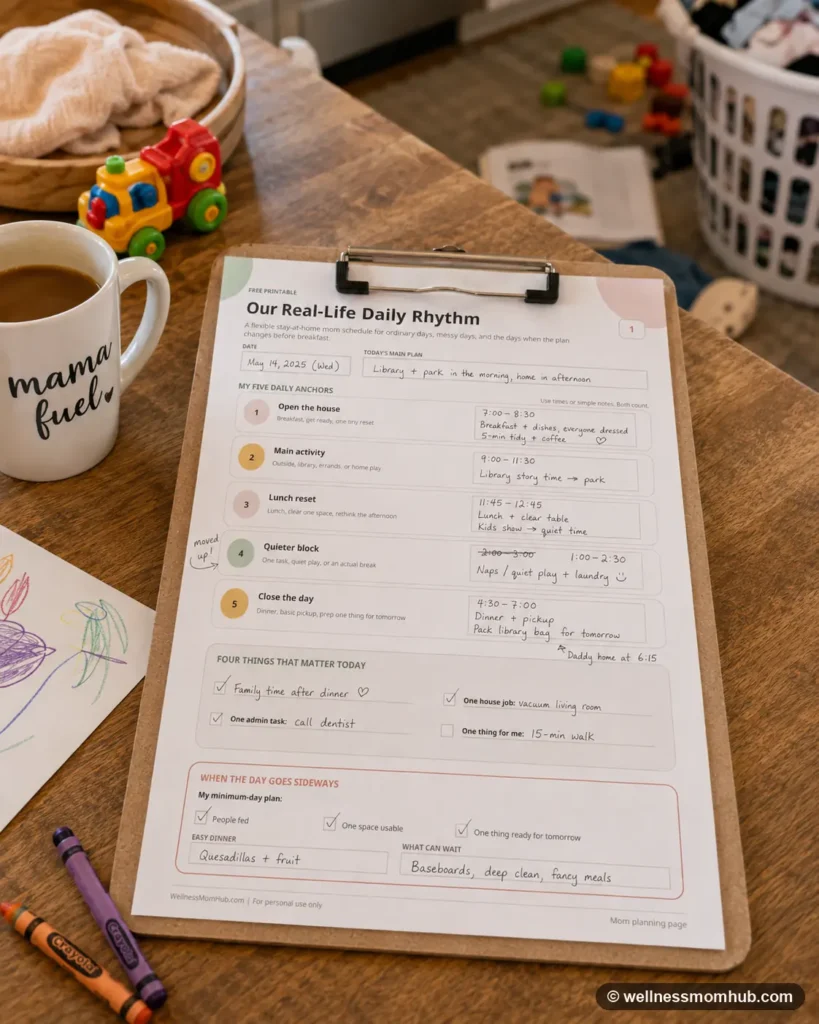
The free editable stay-at-home mom schedule printable turns this routine into three pages you can type into or print. Page one is the daily rhythm sheet with the five anchors, the four things that matter today, and a “when the day goes sideways” minimum-day plan. Page two is a kid page, so your child can circle and check a small job of their own. Page three is a set of cut-out cards for building the day together.
Download it, add your fixed commitments, and test it for several ordinary days. Print one copy for the refrigerator and keep another blank for the weeks when everything changes again.
For the jobs the kids can take on, the age-by-age printable chore chart keeps them off your list without becoming another system to manage.
The evening close is easier with a set sequence. These bedtime routines for 3 year olds include a five-minute version for the nights that get away from you.